An electricity affordability crisis is sweeping across the United States and the situation is particularly acute in California, where electricity rates are the second highest in America — double the U.S. average.[1] Understandably, 83 percent of Californians rank lowering bills as a top or important priority for state leaders to address.[2]
Fixing this crisis won’t be fast or easy, but utility regulators and California’s state officials can tap seven policy solutions to bring much-needed relief to California residents.New analysis, developed by Energy Innovation and GridLab,[3] reveals shows how the governor, state legislator, and utility regulators can curb the three drivers of increasing prices: utility costs (the total size of costs), rates (who pays for the costs), and wildfire (the fastest growing part of costs). Drawing policy insights from a workshop held with over 20 California electricity experts, the new report sets out a path to stabilize electricity rates and ultimately bring down prices.
These policy solutions couldn’t come at a more critical time. Surging electricity costs are threatening California consumers and making the state’s industries less competitive.[4] From a climate policy perspective, California’s high electricity rates threaten to undermine the state’s ambitious clean energy deployment strategy and goals. But, if the state’s leaders can take the right near-term steps, they can reverse the upward cost trend – stabilizing rates, reducing the burden on customers, and making it more affordable for businesses to adopt clean technology.
What’s driving up California’s electricity costs?
Many factors contribute to California’s rise in electricity costs, but most of the price increases from 2000-2024 are concentrated among the investor-owned utilities (IOUs), which serve about two-thirds of California’s energy customers.[5]
These IOUs are situated within a complex web of factors which ultimately drive up costs for consumers.
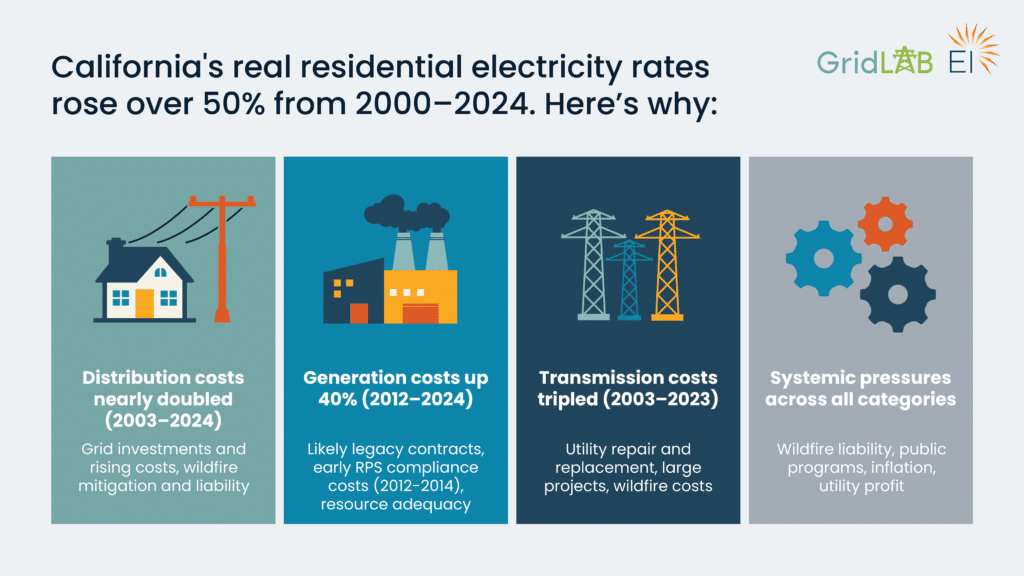
Utility spending: Building, expanding, and maintaining distribution, generation and transmission infrastructure[6] — which creates electricity, carries it long distances, and delivers it to homes and businesses — is expensive. Distribution, including investments in advanced meters and smart grid infrastructure, is the largest piece of the bill. The cost to generate power also contributes to customer rates, and increased 40 percent between 2012-2024.[7] And while transmission is the smallest portion of the electricity bill compared to distribution and generation, it has tripled since 2003 (from $1.8 billion up to $5.7 billion in 2023).
Regulation and rules: The state’s rulemaking and regulatory system shapes how and what utilities spend, and ultimately what customers pay. However, current rules don’t reward utilities for keeping costs down, and the state’s mechanisms to track utility costs aren’t built to catch overspending. Additionally, some public programs — like California Alternate Rates for Energy program, energy efficiency and low-income energy efficiency, and early-stage technology deployment — are required by law and funded by customers.
Idle capacity: California’s grid is built for the hottest and highest demand days, but on average days, much of that electricity capacity sits used. This “declining system utilization” drives up rates, because customers still pay to keep a larger-than-needed system ready.
Wildfires: One large, growing threat driving up costs across the board is wildfire risk.[8] It’s no secret California has battled increasingly devastating wildfires in recent years, given rising temperatures and worsening drought conditions caused by climate change. This creates a major financial challenge for utilities since, under California law, they are strictly liable for property damage due to wildfires caused by their equipment. As a result, utilities have spent significant money to prevent wildfires and compensate victims where they’ve been found liable[9] – these add up to major distribution, transmission, and operations and management costs. Wildfire risk even affects how much utilities pocket when undertaking big capital projects, and the California IOUs’ returns on equity are generally higher than peer utilities due in part to investors’ perceptions of risk around wildfire liability.
Here’s How California’s State Officials Can Lower Electricity Rates
Some of the pressures driving higher electricity rates can’t be relieved immediately. But California’s leaders and government officials have seven clear ways to address regulatory weaknesses, better align incentives, and tackle the question of who pays for what system costs.
The first order of business is putting the tools and structures in place to improve regulatory oversight of utility spending and encourage utilities to lower costs – in other words, “putting utilities on a budget.”
How government officials can increase oversight and cut total utility costs:
- Reduce regulatory overhead, such as simplifying regulatory processing and improving the permitting process to reduce costs
- Confront distrust and improve oversight and transparency by creating standard reporting templates for cost tracking
- Align utility incentives with affordability by putting IOUs on a budget, limiting excess utility profits, and tying financial performance to cost-savings goals
The second priority is ensuring utility rates allocate costs and risks more fairly between customers and utilities.
How government officials can fairly allocate system cuts:
- Modernize rate design to prioritize improved utilization and equity and prevent electric vehicle and heat-pump electrification savings from being negated by rising rates
- Reduce the role of rates in funding climate mitigation and wildfire prevention by rebalancing costs toward beneficiaries, including utility shareholders and California taxpayers, and build a coordinated framework across agencies and utilities for smarter wildfire mitigation spending
- Lower utility financing costs and risk passed to consumers by changing utilities’ debt-to-equity ratio and leveraging lower-cost capital and public financing
- Encourage customer flexibility and improve grid efficiency by combining state electrification incentives[10] with rate design and by leveraging flexible large loads to improve electricity system utilization
There’s no silver bullet to cut electricity prices right away, but we can stop the seemingly never-ending rise in rate hikes. California’s incoming governor, the California Public Utilities Commission, and state legislature have a range of solutions at their disposal.[11]
If those in power take swift action and enact these changes, they could begin reversing skyrocketing utility cost increases, help lift the burden of heavy electricity bills from California’s customers, and give the state a chance to lead as demand continues to grow.
[1] U.S. Energy Information Administration, “Electricity Monthly Update,” U.S. Energy Information Administration, 2026, https://www.eia.gov/electricity/monthly/update/.
[2] Deploy Action, “New Polling: California Voters Want Decisive Action To Bring Electricity Costs Down,” Deploy Action, 2026, https://www.deploy-action.org/newsroom/new-polling-california-voters-want-decisive-action-to-bring-electricity-costs-down?utm_source=linkedin&utm_medium=social&utm_campaign=california&utm_content=phil/.
[3] Mike O’Boyle, Ric O’Connell, Et al., “Making California’s Electricity Cheaper: An Affordability Agenda For The Golden State,” Energy Innovation, 2026, https://energyinnovation.org/report/making-californias-electricity-cheaper-an-affordability-agenda-for-the-golden-state/.
[4] Shannon Stirone, “Fixing California’s Electricity Prices: Q&A With GridLab’s Ric O’Connell,” Substack, 2026, https://thepowerline.substack.com/p/fixing-californias-electricity-prices/.
[5] Energy Innovation, “U.S. Electricity Bills Are Rising Fast: Which States Are Paying More – And Why,” Energy Innovation, 2026, https://energyinnovation.org/expert-voice/u-s-electricity-bills-are-rising-fast-which-states-are-paying-more-and-why/.
[6] Michelle Solomon, “What Is Surplus Interconnection? And Why It Could Unlock The U.S. Power Grid,” Energy Innovation, 2026, https://energyinnovation.org/expert-voice/what-is-surplus-interconnection-and-why-it-could-unlock-the-u-s-power-grid/.
[7] Mike O’Boyle, Ric O’Connell, Et al., “Making California’s Electricity Cheaper: An Affordability Agenda For The Golden State,” Energy Innovation, 2026, https://energyinnovation.org/report/making-californias-electricity-cheaper-an-affordability-agenda-for-the-golden-state/.
[8] Chris Franklin, “Wildfire Risk In California Could Lead To Power Outages For Thousands of Residents,” Yahoo! News, 2026, https://www.yahoo.com/news/weather-news/articles/wildfire-risk-california-could-lead-215754528.html/.
[9] Cheri Mossburg, “California’s Utility Giant P&E Pays $55 Million Settlement Over Kincaide And Dixie Wildfires,” CNN, 2026, https://www.cnn.com/2022/04/11/us/california-pacific-gas-and-electric-settlement/.
[10] Brendan Pierpont, Matthias Fripp and Michelle Solomon, “Let The Sun In: Clean Energy Is The Cheapest Way To Meet Rising Demand,” Energy Innovation, 2026, https://energyinnovation.org/report/let-the-sun-in-clean-energy-is-the-cheapest-way-to-meet-rising-demand/.
[11] Mike O’Boyle, Brendan Pierpont and Michelle Solomon, “Energy Leadership In A Time Of Need: Remove Barriers To Clean Energy,” Energy Innovation, 2025, https://energyinnovation.org/report/energy-leadership-in-a-time-of-need-remove-barriers-to-clean-energy/.