Get Access
Your information will not be used for marketing purposes and we never sell your data!
All research licensed under CC BY 4.0
Executive Summary
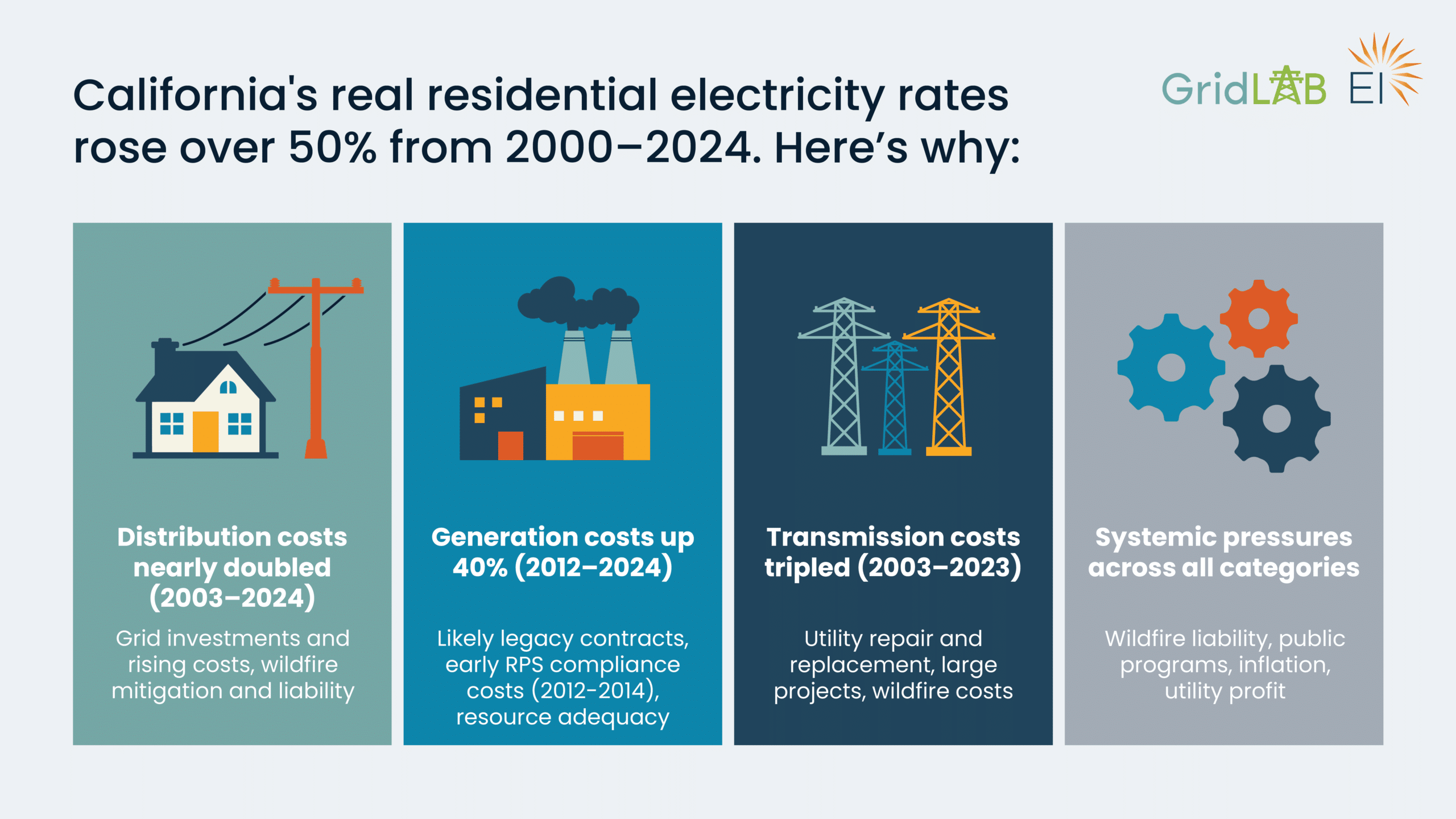
Affordability is at the heart of almost every policy conversation across the nation, and California is facing a particularly acute energy affordability crisis –– the state’s electricity rates are now the second highest in the nation, double the country’s average.[1] Between 2000 and 2024, California’s electricity rates rose faster than inflation and became the highest in the contiguous United States, more than 50 percent higher than the U.S. average.[2] These prices are untenable, straining household budgets, and threatening the state’s electrification path to a climate-neutral economy.
More than 80 percent of Californians rank lowering bills as a top or important priority for state leaders, and the state’s elected officials have a duty to address these intertwined problems for their constituents.[3] Failure to address California’s rising rates also risks the state’s progress toward lowering its greenhouse gas emissions, which itself is a root-cause affordability tool as wildfires grow more severe with a changing climate and the associated risks and mitigation grow more expensive.
How California’s State Officials Can Lower Electricity Rates
GridLab and Energy Innovation convened a workshop of more than 20 California electricity experts to diagnose what’s causing rising costs and develop actionable policy solutions that address the scale of the challenge. This report is informed but not limited by that workshop. It defines a policy roadmap to stabilize and ultimately reduce electricity rates for California’s incoming governor, the California Public Utilities Commission (CPUC), the legislature, utilities, and other stakeholders, that will allow California to sustain its clean energy leadership.
No one silver bullet can reduce rates, but any path forward must address the underlying structures causing California’s sky-high rates. These complex factors include a mix of increased distribution, generation and transmission costs, misaligned utility incentives, complex and overlapping regulatory and legislative mandates, opaque cost tracking and oversight mechanisms, and declining system utilization – which drives up volumetric based rates.
All these problems sit alongside the difficult reality of wildfire risk that utilities are attempting to solve by spending huge sums of ratepayer money. Unfortunately, the utilities’ financial health and Californians’ safety depend on effective mitigation, but utilities cannot do it efficiently or effectively without coordinated action across local and state governments.
While California’s problems are complex, there are clear, actionable solutions to stabilize and reduce California’s electricity rates. A fuller list of these policy recommendations is available below, and explained in more detail in the full report.
Focus On Lowering Overall Utility Costs
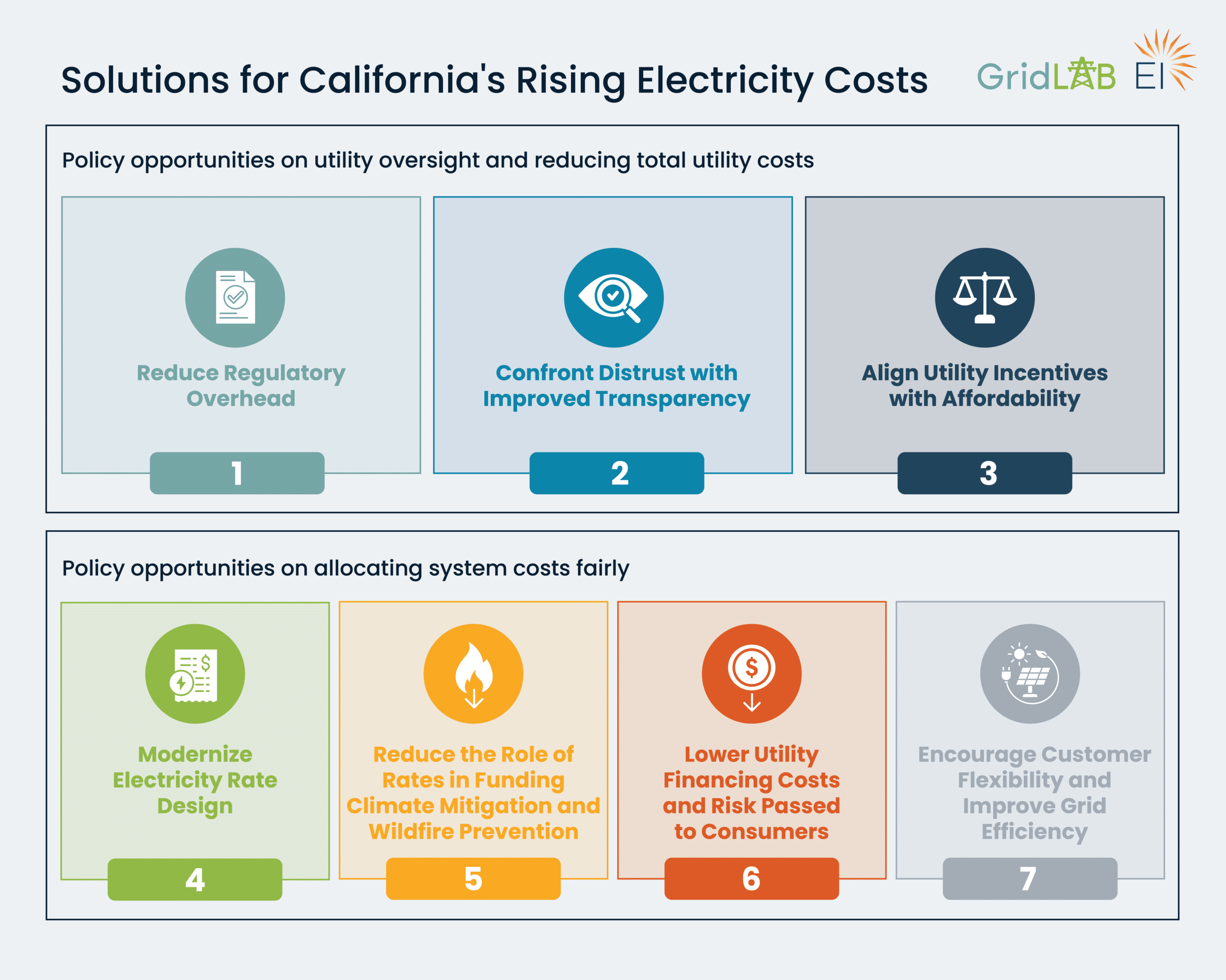
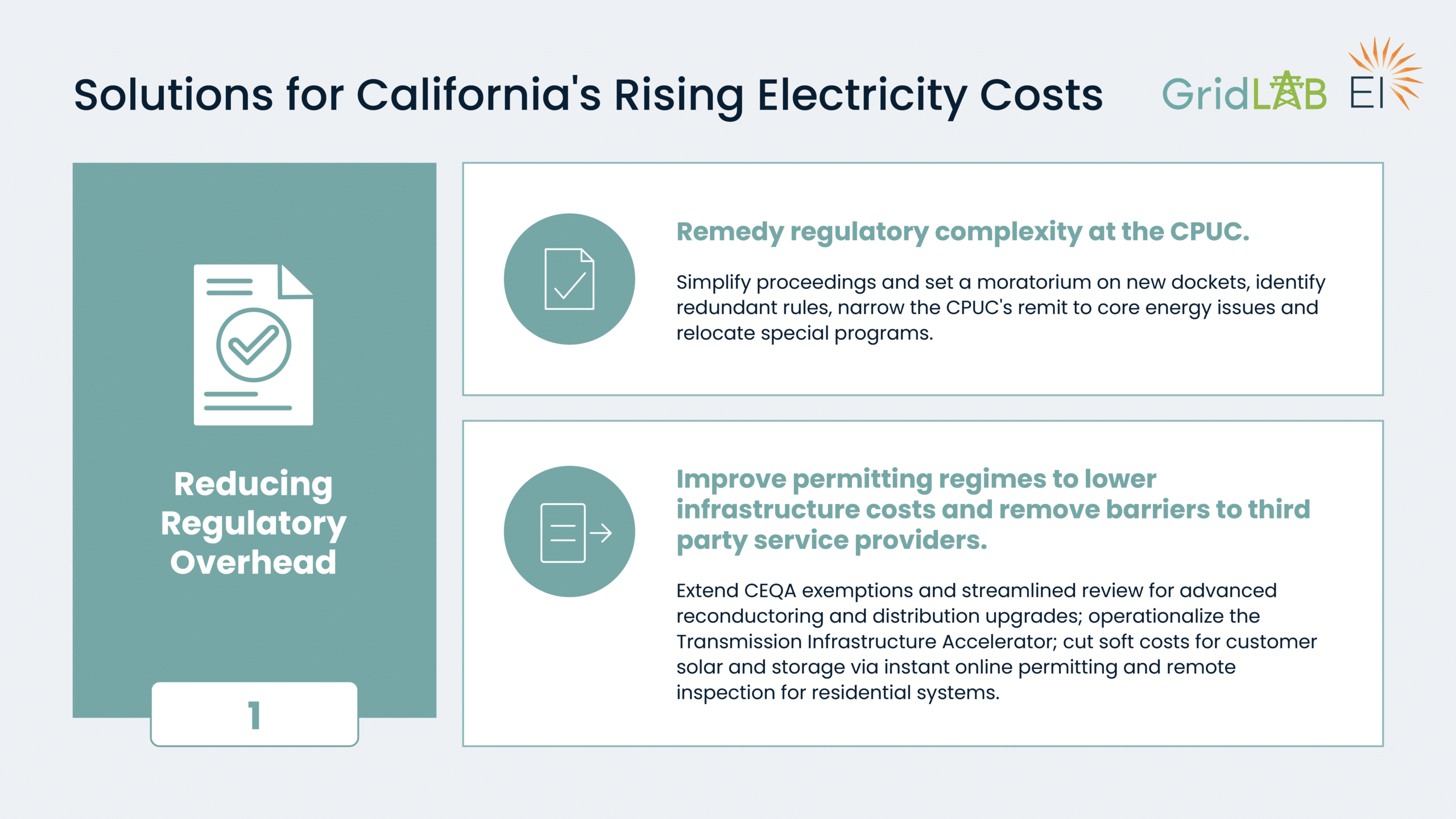
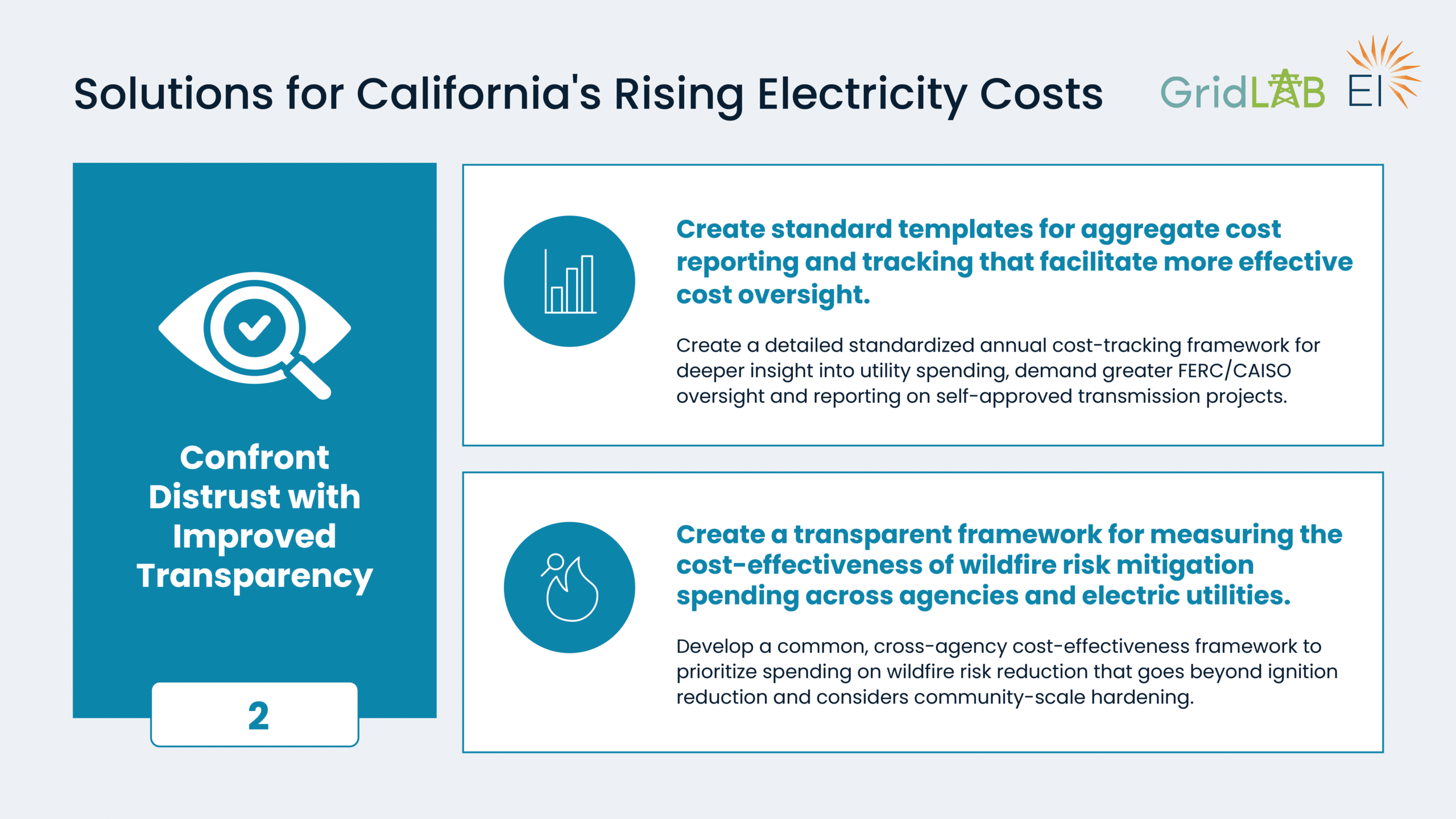
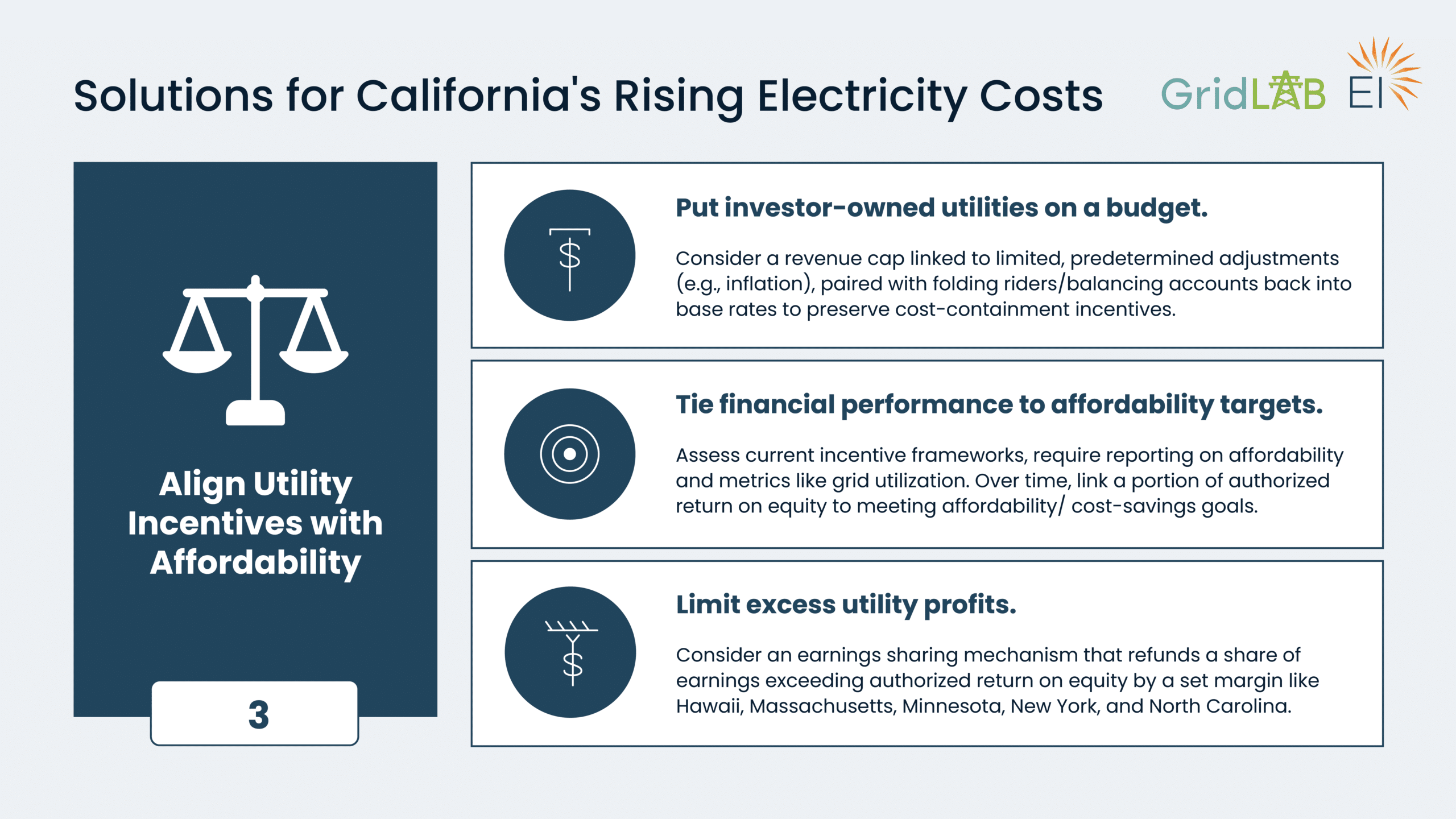
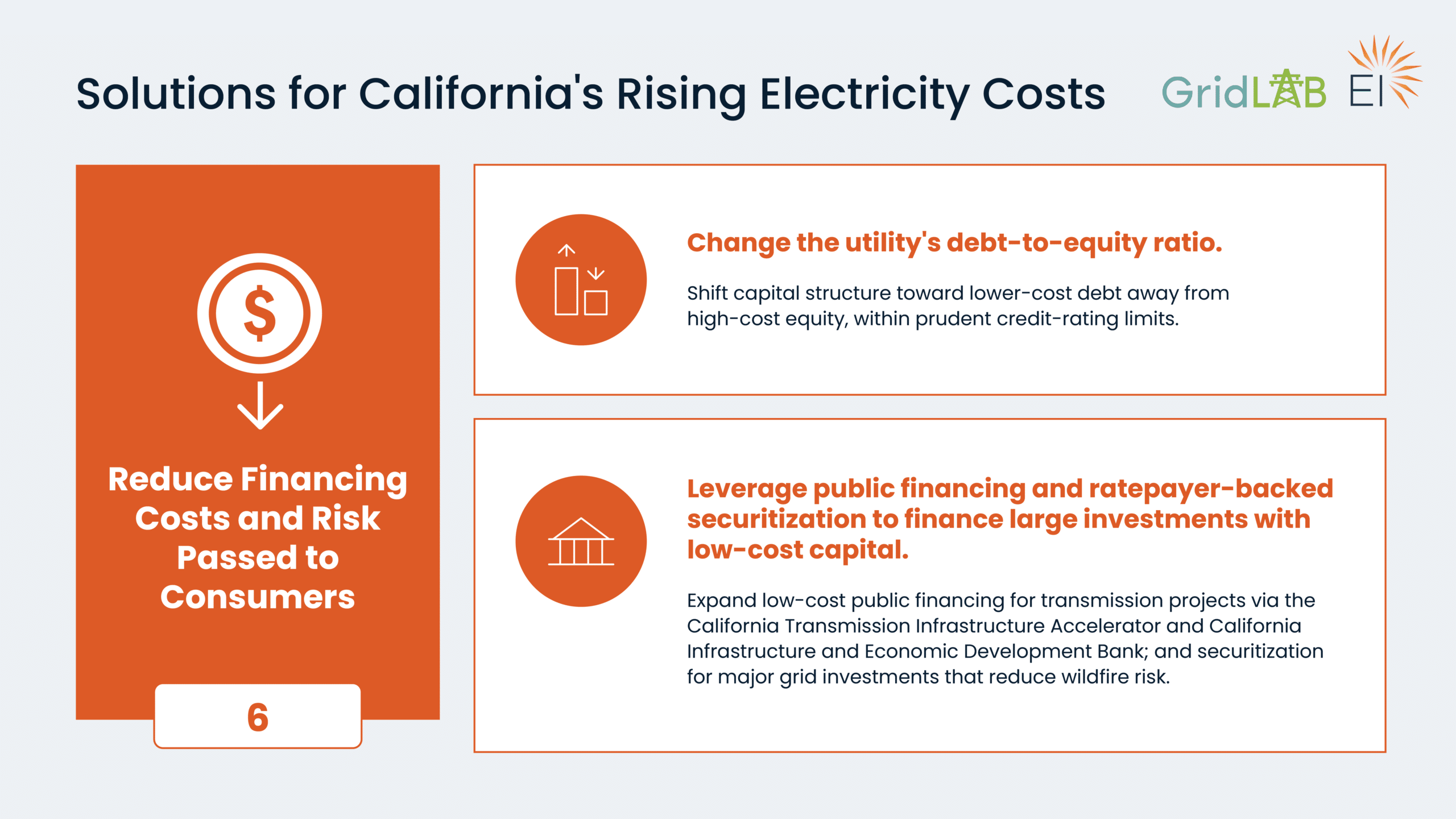
First, California should focus on lowering overall utility costs. This can be done through institutional reforms, regulatory simplification, improvements to cost transparency, better oversight of and alignment of utility incentives with affordability, and strategic wildfire spending. The state needs a concerted effort to simplify regulatory proceedings while pausing new programs and proceedings (to be observed by both the legislature and the CPUC). Regulatory simplification should include permitting reform by state agencies that reduces barriers to energy projects. The CPUC should also refine its methods to improve transparency on utility costs, improving both public reporting and transparency and utility accountability to the CPUC. Similar to standard financial accounting inside utilities or with publicly traded companies, the CPUC could create standard templates for aggregate cost reporting and tracking that facilitate more effective cost oversight, while eliminating redundant mechanisms. To help align utility incentives with affordability, CPUC, authorized by the legislature, could more explicitly put investor-owned utilities on a budget, requiring them to keep rates stable by tying profitability to stabilizing rates and meeting affordability targets established by CPUC. Finally, the state needs a framework to identify how best to invest in wildfire mitigation across agencies and electric utilities, recognizing the problem goes beyond ignition reduction and should consider community-scale resilience to wildfire.
Redistribute The Electricity Grid’s Costs More Fairly
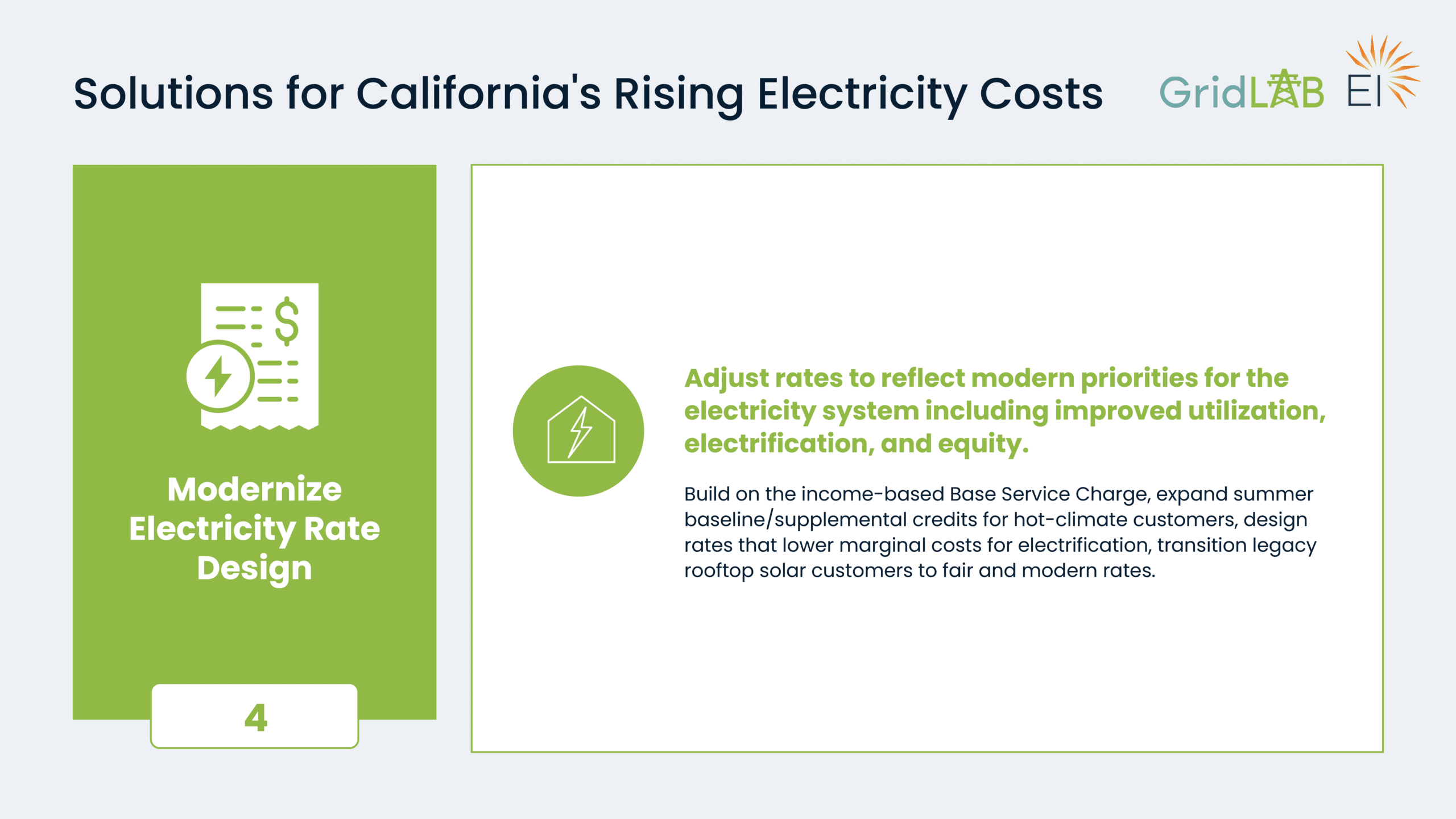
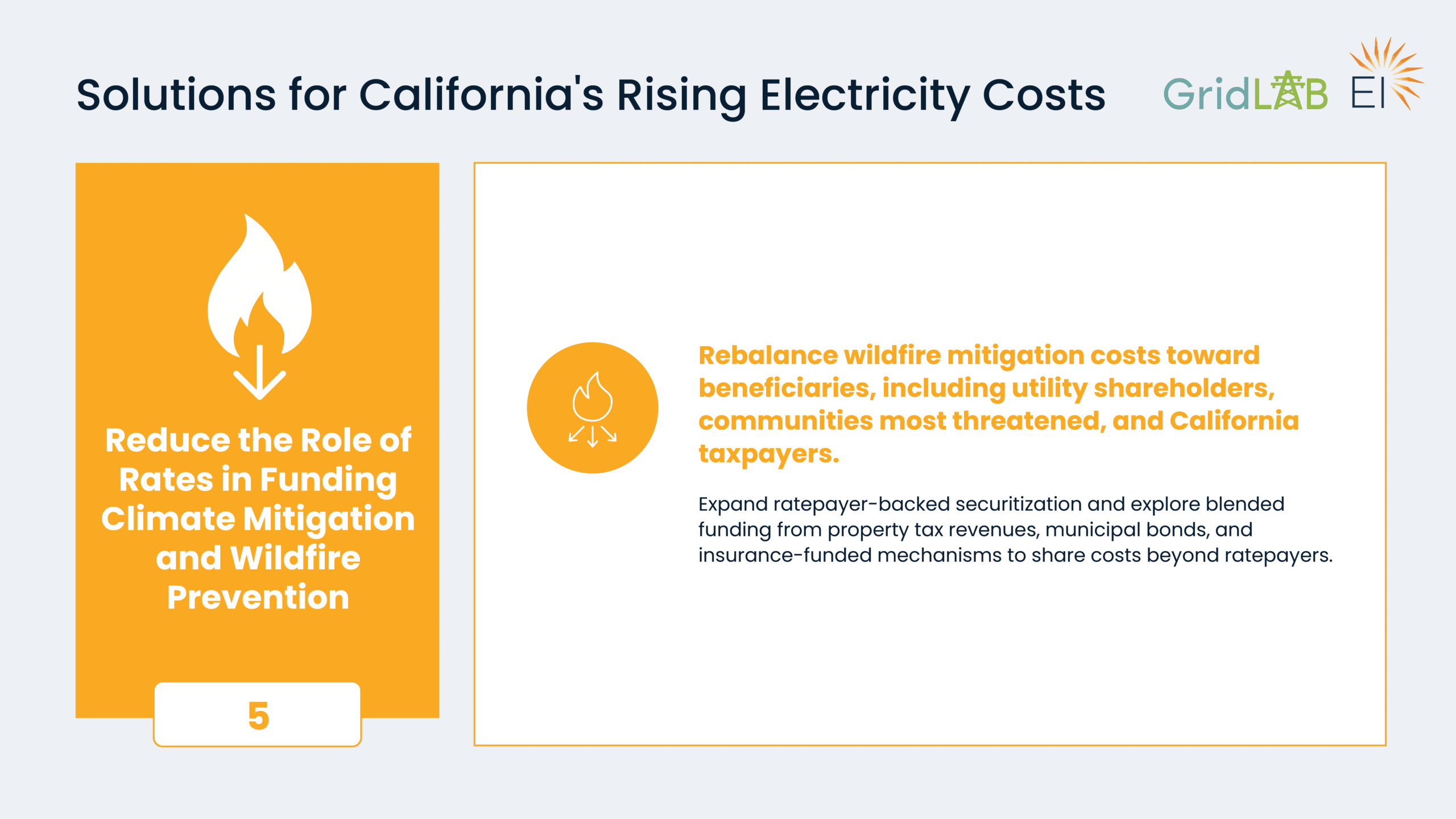
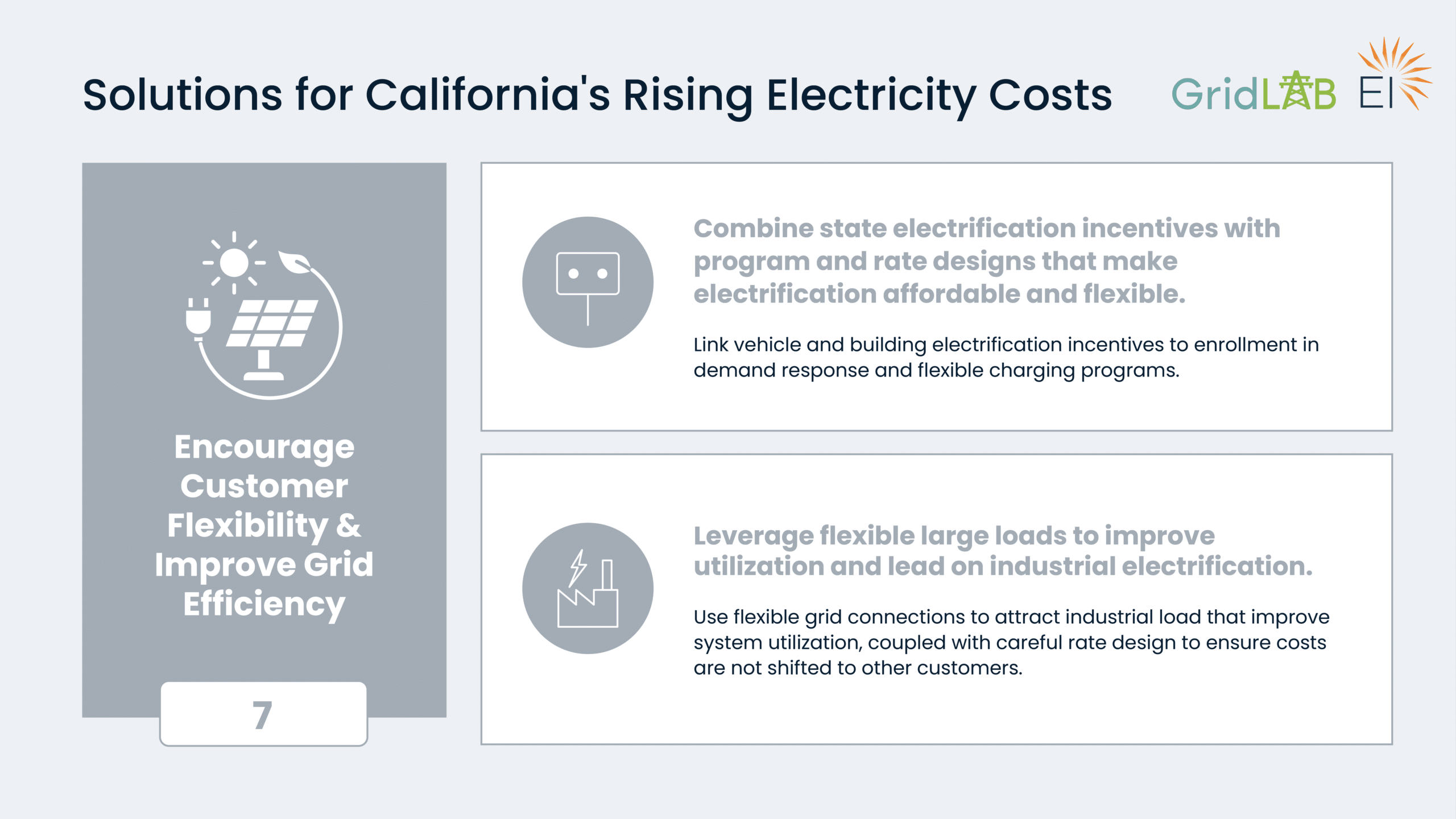
Second, California should redistribute the electricity grid’s costs more fairly. While electric vehicles and heat pumps use energy more efficiently than fossil fuel alternatives, rate increases cut into customer savings. Policies that redistribute fixed system costs to a larger pool of customers through rates can lower electrification costs for all. The cost of wildfire mitigation is also falling disproportionately on electricity rates. Policymakers have an opportunity to build on existing proposals and rebalance wildfire mitigation costs toward beneficiaries, including utility shareholders, most vulnerable communities, and taxpayers. Finally, rates have done a poor job in rewarding customers who use electricity when the grid has spare capacity. Electrification of small and large customers is an opportunity to realign these incentives, both by improving the rates as well as pairing state incentives with enrollment in utility programs, rewarding customers for shifting energy use away from peak periods.
These solutions can empower California’s next wave of leaders to actually solve the state’s electricity affordability crisis instead of ignoring the root problems. These recommendations are for the most part not short-term fixes, but rather long-term policy actions to solve the system-wide forces that would otherwise continue increasing rates. A systematic approach that strengthens regulatory cost mitigation tools, more fairly allocates wildfire costs and risk, and improves the distribution of costs can first slow down spiraling rate increases then reduce them over time.
While the tools for immediate rate relief are limited and have their own implementation challenges, California’s leaders, including the incoming governor, the CPUC, and state legislature have a real opportunity to upgrade the structures that produced this crisis. Doing so will require sustained collaboration across government, utilities, and civil society — but continued rate increases are not inevitable.
[1] U.S. Energy Information Administration, “Electricity Monthly Update,” U.S. Energy Information Administration, 2026, https://www.eia.gov/electricity/monthly/update/.
[2] U.S. Energy Information Administration, “Electricity Monthly Update,”U.S. Energy Information Administration, 2026, https://www.eia.gov/electricity/monthly/update/.
[3] Deploy Action, “Deploy Action poll shows California voters want grid efficiency, utility accountability, and lower power bills press release,” Deploy Action, 2026, https://www.deploy-action.org/newsroom/california-voters-want-grid-efficiency-utility-accountability-and-lower-power-bills.