Get Access
Your information will not be used for marketing purposes and we never sell your data!
All research licensed under CC BY 4.0
Executive Summary
The United States’ energy policy framework has shifted dramatically during the second Trump administration and 119th Congress. Over the past one and a half years, the federal government has overhauled many legislative and regulatory policies, creating significant implications for clean energy deployment.
Energy prices continue rising, exacerbating the affordability crisis Americans are facing. We used the Energy Policy Simulator to model federal policy decisions made since January 2025 to determine what the near future holds for families and businesses in terms of energy costs, public health, job losses, and grid reliability. Our analysis focuses on seven key sets of policy changes:
- Passage of the One Big Beautiful Bill Act (OBBBA)
- U.S. Environmental Protection Agency’s (EPA) reconsideration and repeal of Clean Air Act (CAA) §111 Greenhouse Gas (GHG) Standards, Mercury and Air Toxics Standards, and Clean Water Act Effluent Limitations Guidelines for electric power plants
- U.S. EPA’s repeal of the Endangerment Finding and federal tailpipe emissions standards
- Passage of CAA §177 Congressional Review Act resolutions overturning approvals for state-level tailpipe emissions standards
- Administration actions to limit renewable energy development, especially onshore and offshore wind plants, including limitations on issuance of new permits
- U.S. Department of Energy (DOE) cancellations of hydrogen hub funding and easing of 45V tax-credit qualification for natural gas-based hydrogen
- U.S. EPA’s cancellation of the $7 billion Solar for All grant program
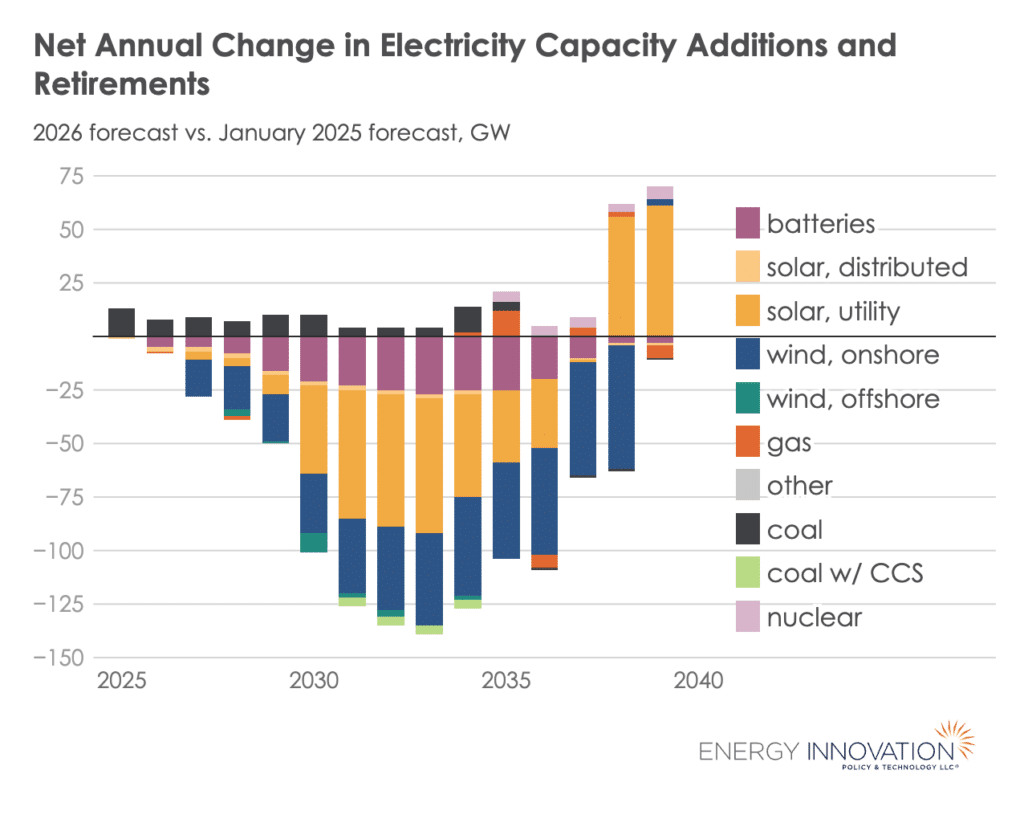
This report analyzes effects of policy changes on energy prices, the economy, air pollution, and healthcare spending from 2026 to 2040. Our modeling shows higher energy costs, worsening public health impacts, and less capacity added to the grid – blocking new generation when it’s needed most and increasing utility costs.
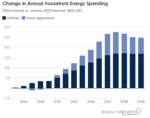
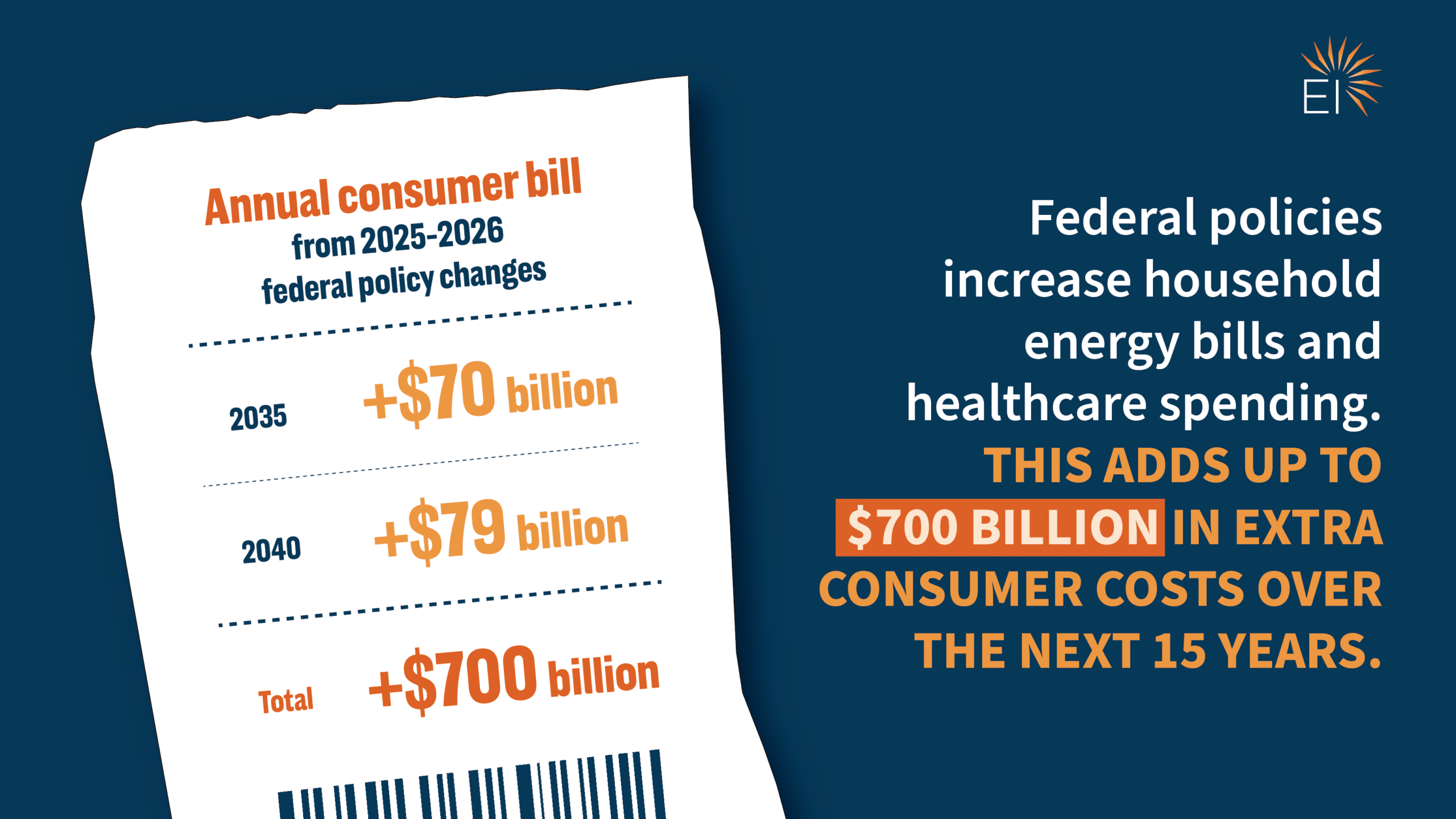
- Households will pay an additional $650 billion for energy – an average of $460 per household in 2035 and $490 in 2040.
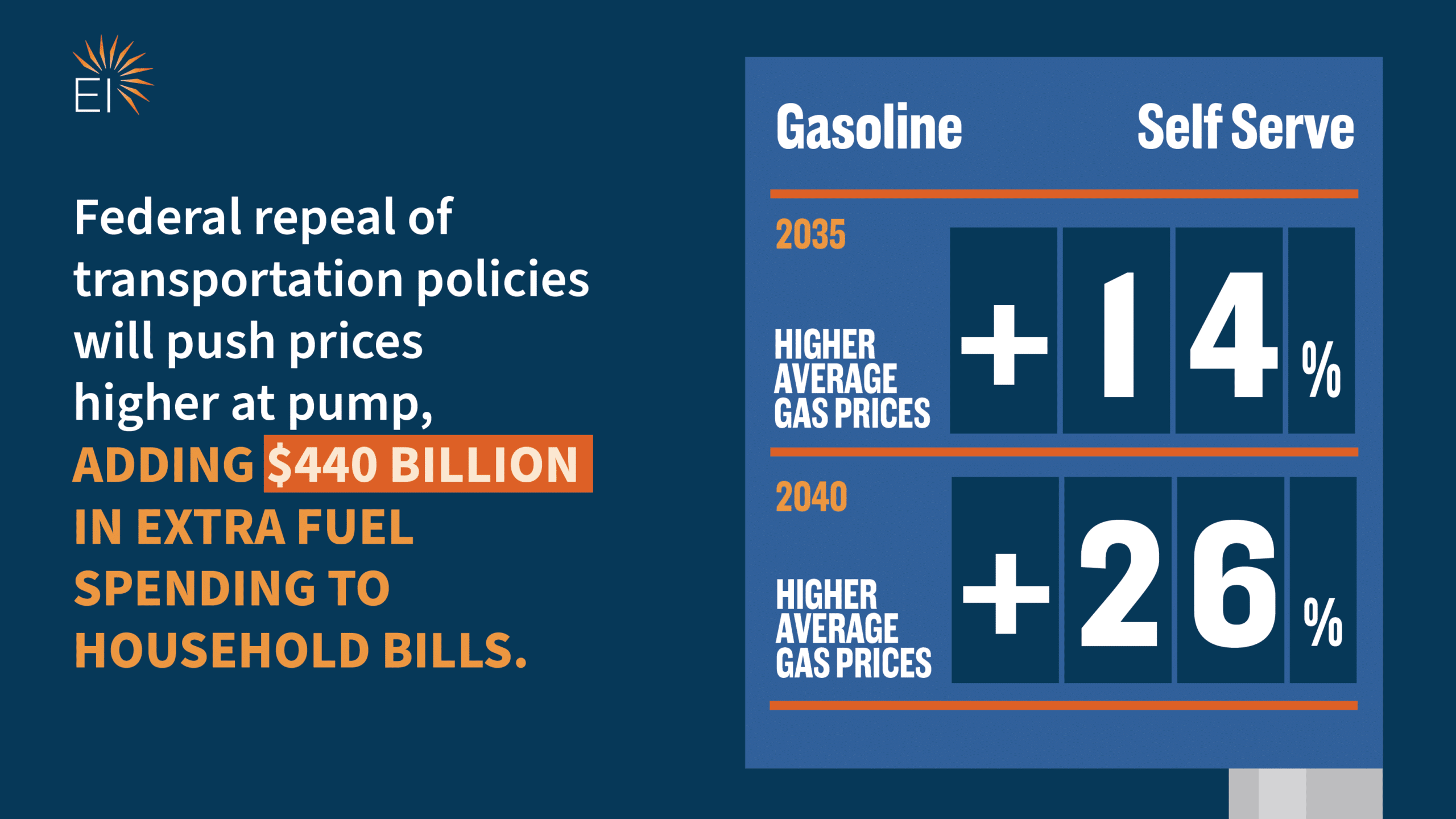
- Cutting policies that drive innovation and efficiency in the transportation sector will inflate gasoline prices 14 percent in 2035 and 26 percent in 2040, atop near-term upward pressure from the Iran war and other market forces.
- OBBBA and reduced federal support for domestic manufacturing and innovation will cost the U.S. economy 820,000 jobs per year on average over the next decade, in addition to the 144,000 clean energy jobs lost[1] within the past 18 months.
- Slowing down electrification and domestic energy manufacturing will lower GDP in all years, totaling $2.3 trillion cumulative lost GDP, with effects flowing into other economic sectors. The U.S. economy will lose $150 billion in GDP in 2030, peaking at a $250 billion net loss in 2032, then reverting to losses of $200 billion in 2035 and $120 billion in 2040.
- Worsening local air pollution will raise healthcare costs by $43 billion, with annual increases of $4 billion in 2035 and $4.5 billion in 2040, contributing to rising household costs alongside rising energy prices and goods inflation.
This analysis focused on energy policies. While we do not explicitly model impacts of the Iran war or of broad-ranging tariffs, their effects are captured in the model and indirectly affect results. For example, the Strait of Hormuz blockade raised gasoline prices, so policies that slow new electric vehicle sales will burden consumers with bigger gasoline bills than if the war hadn’t taken place. Tariff and inflationary pressure on technology prices and consumer costs up to 2026 are also incorporated where our source data factors in those impacts.
This means our assessment of net change in costs, particularly on households, should be considered conservative.
State leaders have options to help insulate their constituents from these impacts in meaningful ways: Energy Innovation’s state policy blueprint[2] lays out five no-regrets actions state and local governments can take until federal policies change. While these actions can’t replace the pollution reductions and total affordability measures provided by strong federal policy, they can limit price increases, improve health, and add new capacity to the grid.
- Help hundreds of gigawatts of wind and solar projects[3] qualify for expiring tax credits under safe harbor rules by ensuring they are placed into service by the end of 2030 and pushing utilities to contract with and connect these resources quickly where they would save consumers money.
- Remove barriers to additional clean energy deployment[4] by providing permitting certainty, improving the use of existing grid infrastructure, reducing soft costs, and cutting red tape for businesses and households to install clean energy.
- Sustain momentum for electric transportation[5] through a mix of policies that will bolster the growing market for EVs and charging infrastructure.
- Double down on efficiency and electrification for buildings and factories[6] by supporting technologies that provide efficient heat and cooling; adopting modern energy codes and standards; offering incentives and enable financing to level the playing field for energy saving measures.
- Stimulate investment in new clean industries,[7] such as modern, efficient heating equipment and industrial parks designed to reduce the infrastructure costs and investment risks of cleaner manufacturing.
[1] Climate Power. “SnapShot: Trump’s Energy Crisis Spikes Utility Bills By 16%,” June 2026, Climate Power, https://climatepower.us/wp-content/uploads/2026/06/June-2026-Energy-Crisis-Snapshot.pdf.
[2] Mike O’Boyle, Sara Baldwin, Chris Busch, Michelle Solomon, Brendan Pierpont, Sonali Deshpande, Nik Sawe, and Dan Esposito, “Energy Leadership In A Time Of Need: A Blueprint For States,” Energy Innovation, August 2025, https://energyinnovation.org/report/energy-leadership-in-a-time-of-need-a-blueprint-for-states/.
[3] Mike O’Boyle, Michelle Solomon and Brendan Pierpont, “Energy Leadership In A Time Of Need: Accelerating Near-Term Solar And Wind Procurement,” Energy Innovation, August 2025, https://energyinnovation.org/report/energy-leadership-in-a-time-of-need-accelerate-near-term-solar-and-wind-procurement/.
[4] Mike O’Boyle, Brendan Pierpont and Michelle Solomon, “Energy Leadership In A Time Of Need: Remove Barriers To Clean Energy,” Energy Innovation, August 2025, https://energyinnovation.org/report/energy-leadership-in-a-time-of-need-remove-barriers-to-clean-energy/.
[5] Sara Baldwin and Chris Busch, “Energy Leadership In A Time Of Need: Sustain Momentum For Electric Transportation,” Energy Innovation, August 2025, https://energyinnovation.org/report/energy-leadership-in-a-time-of-need-sustain-momentum-for-electric-transportation/.
[6] Sara Baldwin, Nik Sawe and Sonali Deshpande, “Energy Leadership In A Time Of Need: Double Down On Efficiency And Electrification For Buildings And Industry,” Energy Innovation, August 2025, https://energyinnovation.org/report/energy-leadership-in-a-time-of-need-double-down-on-efficiency-and-electrification-for-buildings-and-industry/.
[7] Sonali Deshpande, Nik Sawe, and Dan Esposito, “Energy Leadership In A Time Of Need: Stimulate Investment In New Clean Industries,” Energy Innovation, August 2025, https://energyinnovation.org/report/energy-leadership-in-a-time-of-need-stimulate-investment-in-new-clean-industries/.