
Get Access
Your information will not be used for marketing purposes and we never sell your data!
All research licensed under CC BY 4.0
Executive Summary
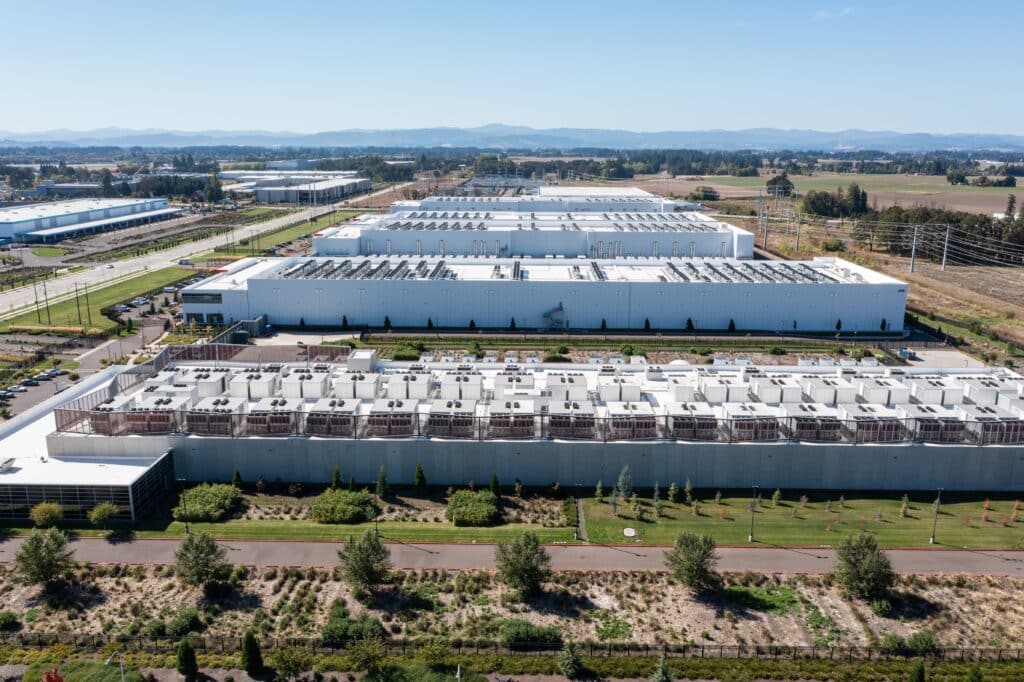
In multiple states[1], massive new data center campuses[2] have reversed years of flat or declining electricity demand, leaving utilities and policymakers scrambling for solutions.
Faced with this onslaught of new demand, many utilities and developers have fallen back on old habits by adding new gas plants, refurbishing older expensive coal units, or turning to nuclear partnerships along with extensive grid upgrades near new load centers – the “firm fixation.”
This reflects an outdated belief that only firm resources and major transmission upgrades can handle data centers’ needs. Yet this approach overlooks two essential truths: First, power plants and data centers are both parts of a larger, interconnected system. Second, data center loads, especially those driven by artificial intelligence, are far more dynamic than the flat, baseload profiles they are often assumed to be.
Firm fixation leads utilities and regulators to default to outdated firm-generation solutions instead of modern, modular approaches that consider the full complexities of today’s power grid. At the scale of even the most compact new data center, connecting to the grid is no small matter.
Regardless of approach, three features of recent growth are well known to the electricity industry and policy community, and to some extent the wider public. First, new data center load is being amplified by extreme investment interest in AI. Second, incremental load tends to be highly concentrated due to the nature of the growing individual server need for power and the geographic concentration of data centers. Third, the data center industry’s appetite for new growth is so large, and other facility capital costs so high that new project owners are willing to pay more for power than average existing electricity consumers.
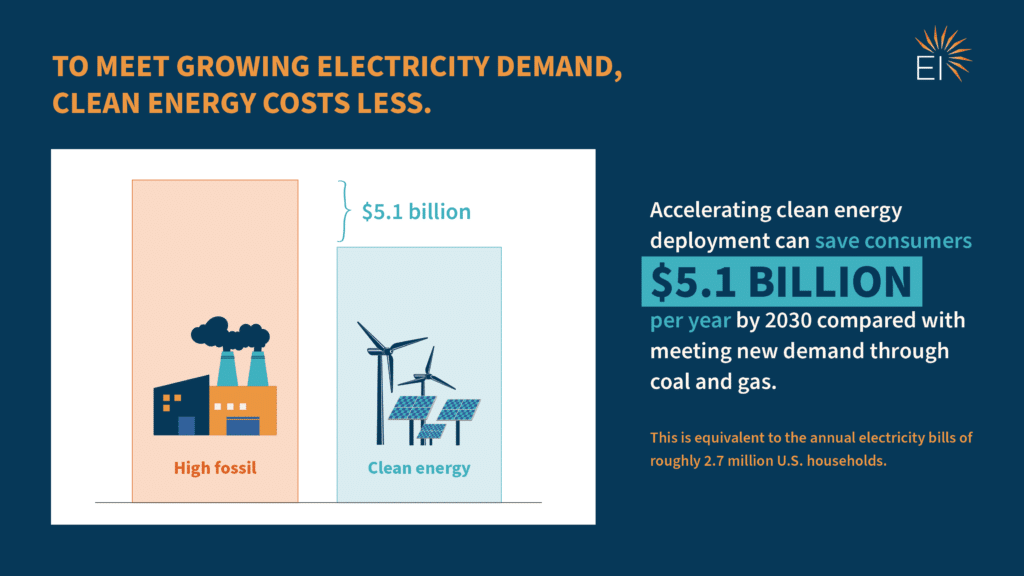
In 2024, Energy Innovation proposed that a portfolio of solutions – clean energy portfolios, advanced transmission technologies, demand-side flexibility, and efficiency – could obviate the need to rush to meet demand with new fossil generation.[3] But government and utility decisions since then may set up the power sector for failure: Either new demand will not be met or the negative cost and performance impacts on other grid users will challenge electricity markets in a dangerous manner.
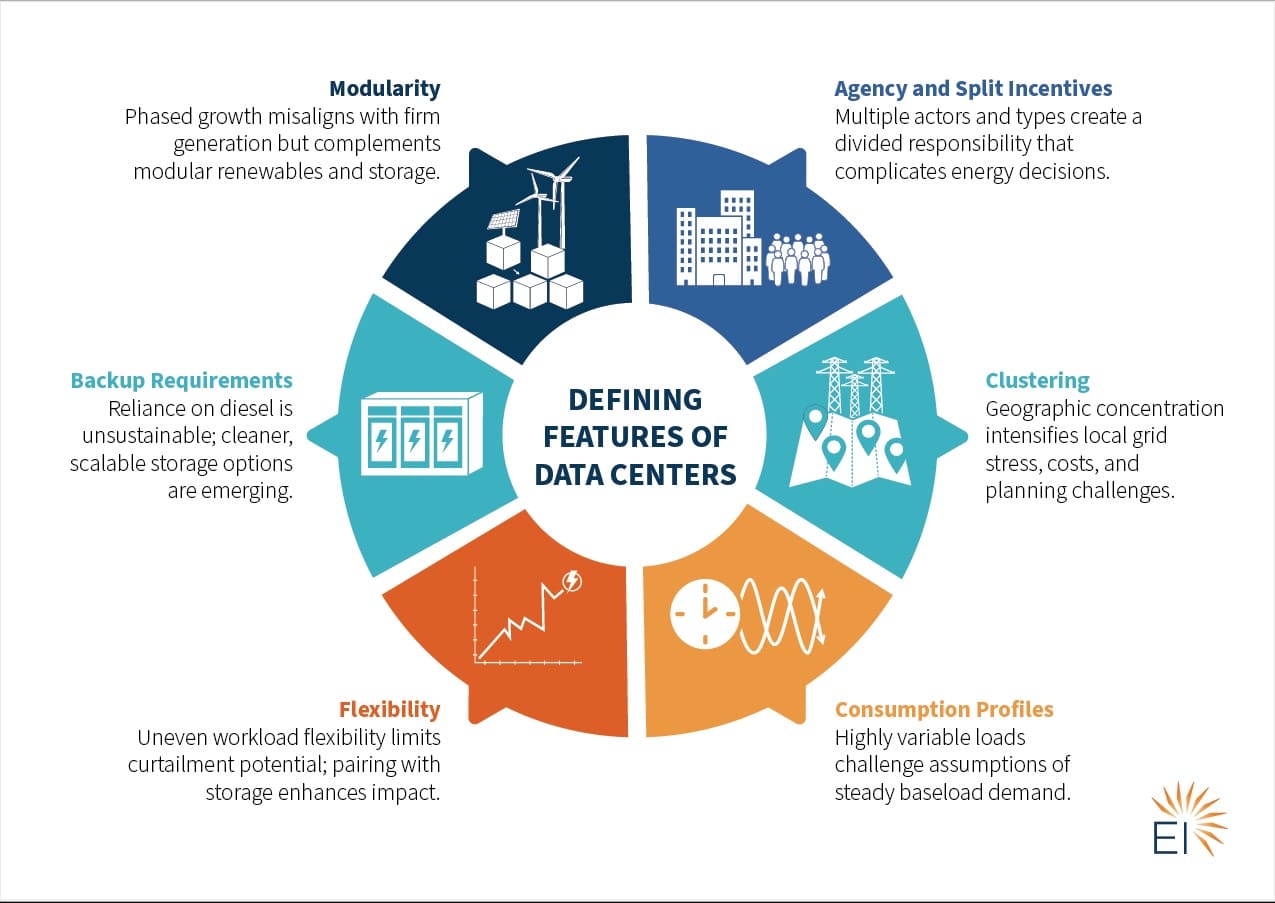
The mad scramble to meet surging data center demand using traditional but crude resource investment methods misses opportunities to manage load growth through a deeper understanding of data centers. Data center electricity demand is problematic because it is concentrated, growing fast, and willing to outspend other users. However, it is also far more complex than the flat, 24/7 block it is often assumed to be. Six defining features provide a more nuanced picture of data centers:
- Agency and Split Incentives – Multiple actors (developers, operators, and tenants) and ownership or usage types of data centers create a divided responsibility over grid interaction and access to energy-saving incentives that complicates energy decisions.
- Clustering – Facilities tend to concentrate geographically, amplifying local grid stress and transmission costs while creating systemic planning challenges.
- Consumption Profiles – Loads are not 24/7 blocks. Instead, they are choppy, with swings of hundreds of megawatts over short intervals, undermining assumptions of steady baseload behavior and potentially affecting the stability of the grid if safeguards are not put in place.
- Flexibility – While some AI-driven workloads can be scheduled for off-peak hours, this flexibility is uneven across facility types and even within users in the same data center campuses. Modest levels of curtailment or load-shifting based demand response during peak hours could ease interconnection bottlenecks and peak demand requirements, but work best in combination with energy storage to overcome split incentives and other complexities.
- Backup Requirements – Relying on diesel for backup generation is unsustainable. Batteries and longer-duration storage are cleaner, more scalable options that create other benefits for the grid if allowed to participate as backup and demand response.
- Modularity – Data centers grow in phases just as demand grows in phases rather than all at once, aligning poorly with “lumpy” firm large one-time investments in dispatchable power plants and infrastructure upgrades, while fitting well with modular renewables and battery deployments. These features undermine the firm fixation logic. One-to-one matching of data centers with dedicated or “captive” firm power plants is particularly unwise for both power generator and new data centers, even given their willingness to pay for speed-to-power. Relying on captive plants for all supply – like pairing a nuclear plant with a large data center – exposes them to outages, inflexibility, and stranded-asset risks, while hybrid co-location deals still rely heavily on the broader grid.
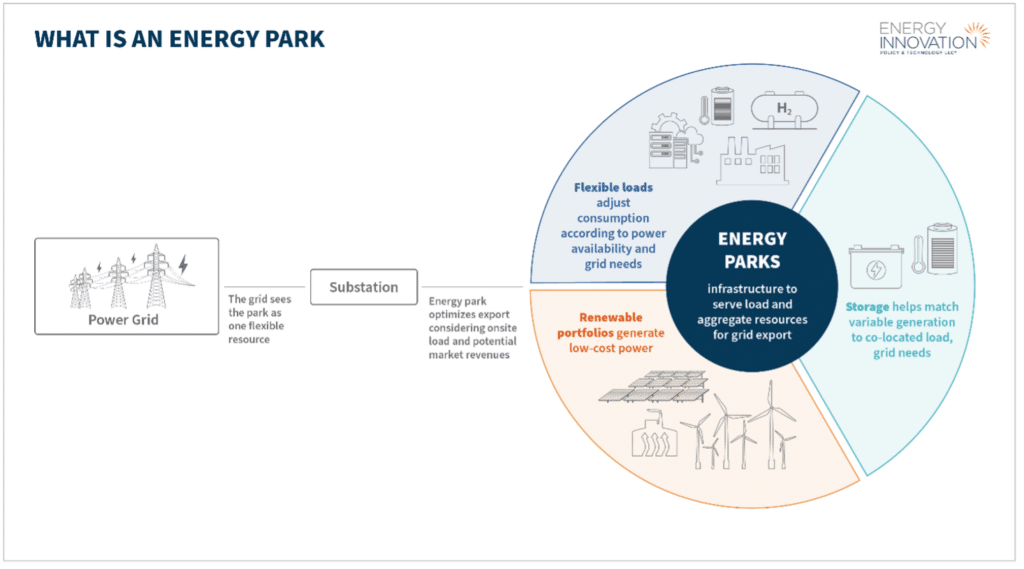
Most new demand will need to be served through the bulk power system, requiring upgrades to interconnection infrastructure, grid services (especially peak capacity), and bulk electricity supply. Once this is established, clear data centers can tap the grid’s advantages as a “system of systems” pooling variable demand and generation resources solutions together to ensure supply and demand match. As peak demand rises, this crucial service must be met, but not necessarily by firm generation. A deeper understanding of data center demand attributes yields a more complete solution set which includes data center flexibility, onsite storage, portfolios of clean energy, and others.
The challenges data centers pose include lengthy interconnection queues, peak stress, price impacts, and rising emissions – but these are not insurmountable. Three core lessons emerge for policymakers and stakeholders:
- Data center interconnection to the grid is the moment of maximum leverage: not to extract unreasonable concessions, but to ensure new entrants cover the full costs of the infrastructure they trigger, and to nudge data center developers towards solutions such as flexible demand or local storage that relieves local bottlenecks and supports the broader grid. It is the moment to ensure consumption tariffs reflect cost causation, encourage flexibility, and align incentives without imposing unworkable burdens later. Likewise, developers and customers should lean toward local fixes that speed access to the grid, improve power quality, and ease broader impacts—reducing the likelihood of being saddled with extraordinary requirements later.
- Household electrification and distributed resources can free up tens of gigawatts at costs comparable to new gas plants and on a faster timetable, offering a more pragmatic and equitable path to integration. Yet state and regional level policy innovation still lags behind. Several widespread mechanisms exist to channel data center owners and operators’ willingness to pay into new solutions that help other existing customers accommodate rapid data center load growth in a fair, fast and equitable way. Because grid connection bottlenecks can be managed by multiple combinations of diverse resources, data centers don’t need to do all the work of mitigating grid impacts onsite or through a single counterparty. Once a data center has invested in flexibility and equipment to resolve local connection issues, additional constraints such as upstream transmission and grid services bottlenecks as well as large incremental amounts of annual electricity delivery can be addressed with demand-side solutions from other grid users. A recent report from Rewiring America proposes that many resources needed to meet data center load growth could come from sponsoring household upgrades instead of new generation.[4]
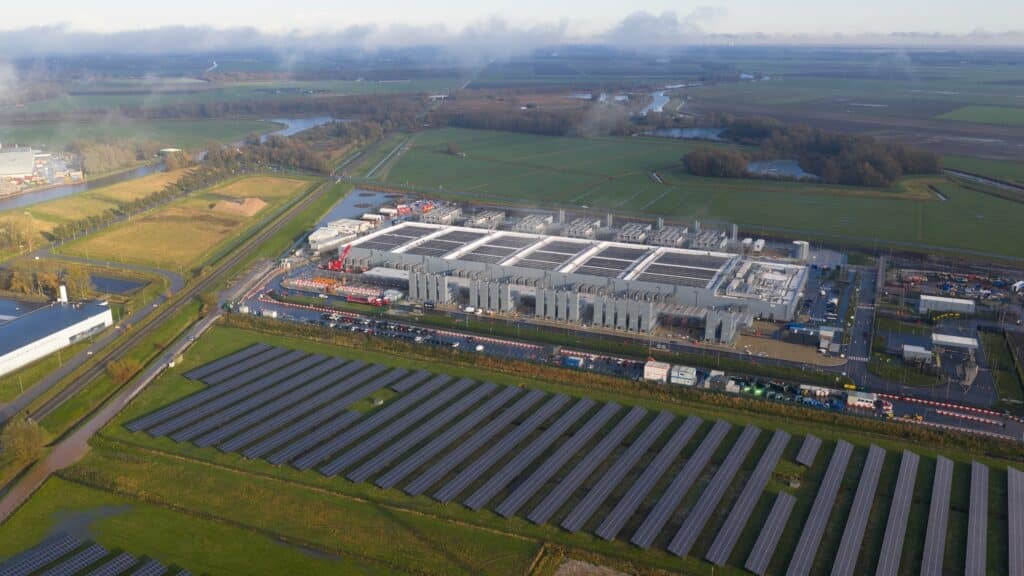
- Batteries and managed demand ease all manner of data center impacts and accelerate renewable integration, providing cleaner, faster, and cheaper capacity than firm fossil solutions. Because batteries are increasingly essential for buffering, backup, and power quality, they also provide a built-in solution for integrating variable renewables—a two-for-one win. Furthermore, renewable plus-battery solutions can capitalize upon existing surplus interconnection to quickly connect data centers to the grid in co-located arrangements.
This report challenges the electricity and data center industries to move beyond a firm fixation and adopt solutions that leverage the full capabilities of modern power systems. What began as a major strain on the grid can become the catalyst for building a smarter one, supporting both the digital economy’s explosive growth and the clean energy transition
[1] Ana Boyd and Todd Olinsky-Paul, Load Growth: What States Are Doing to Accommodate Increasing Electric Demand (Clean Energy States Alliance, July 2, 2025), https://www.cesa.org/resource-library/resource/load-growth-what-states-aredoing/.
[2] Cushman & Wakefield, 2025 Global Data Center Market Comparison, May 7, 2025, 31, https://www.cushmanwakefield.com/en/insights/global-data-center-marketcomparison.
[3] Eric Gimon, Mike O’Boyle, and Michelle Solomon, Meeting Growing Electricity Demand Without Gas (Energy Innovation, March 28, 2024), https://energyinnovation.org/report/meeting-electricity-demand-without-gas/.
[4] Rewiring America. “Homegrown Energy: How Household Upgrades Can Meet 100 Percent of Data Center Demand Growth.” September, 2025, https://www.rewiringamerica.org/research/homegrown-energy-report-ai-data-centerdemand.