


Get Access
Your information will not be used for marketing purposes and we never sell your data!
All research licensed under CC BY 4.0
Executive Summary
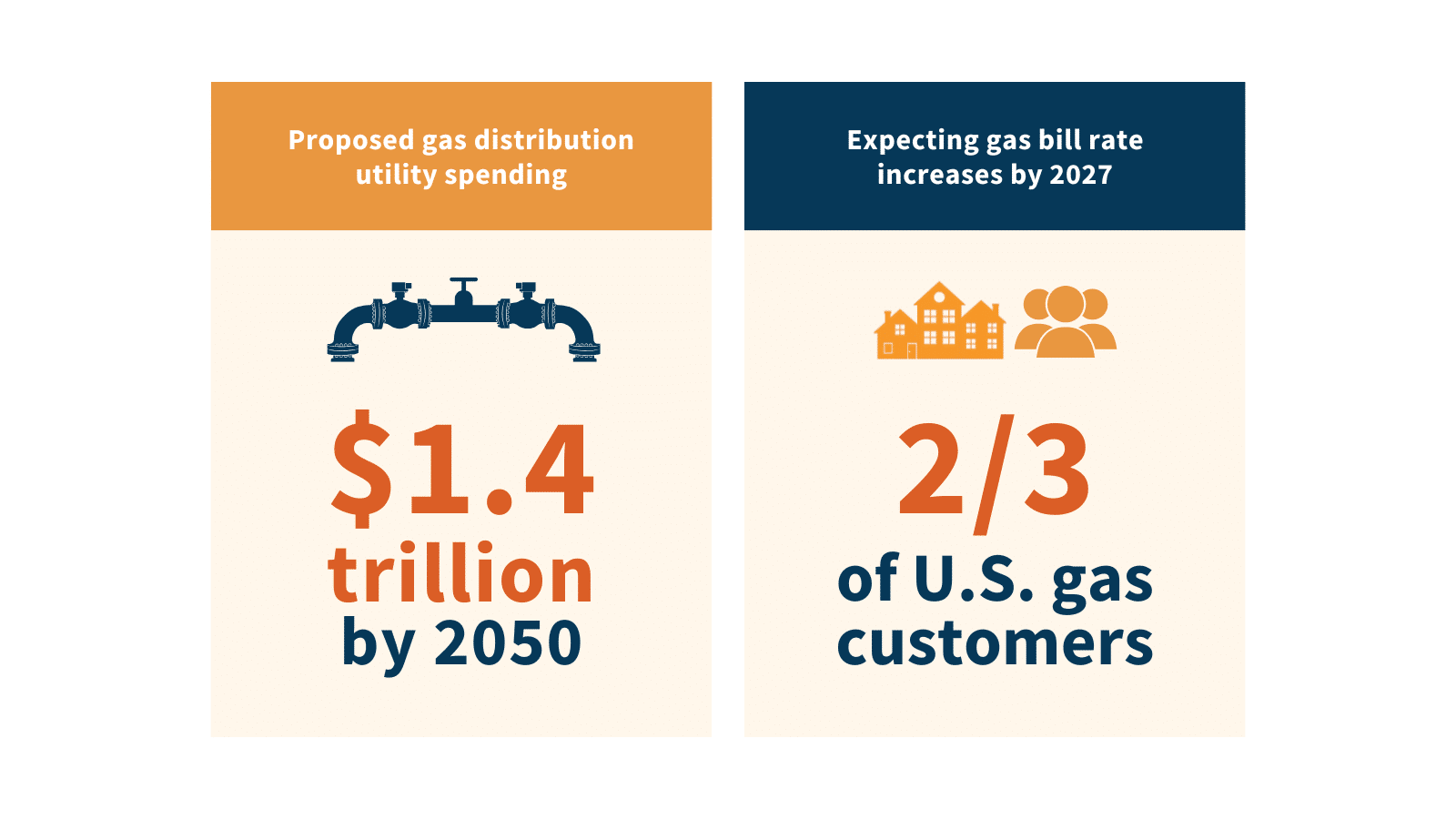
State regulators face a looming problem. Amid America’s energy affordability crisis, gas utilities are proposing up to $1.4 trillion in new spending by 2050 – and utility customers will be forced to pick up the tab. Regulators need new tools and approaches to evaluate utility spending proposals and help utilities pursue solutions that reduce costs and risks for energy consumers.
Every month, hundreds of millions of American households and businesses allocate a percentage of their income to utility companies—to keep their lights on, their machines humming, and their water hot. Across the residential, commercial, and industrial sectors, nearly 164 million electricity consumers1 and nearly 72 million fossil gas (aka natural gas) consumers pay energy bills.2 These two large energy systems— separate but intertwined—have a disproportionate impact on the approximately 43 percent of customers paying for both electric and gas service.
In most states, electric utilities and gas distribution utilities are simultaneously pursuing massive infrastructure investments. Total spending by investor-owned electric utilities is projected to reach $207.9 billion in 2025 (up from $139.8 billion in 2020—a nearly 50 percent increase), with more than $1.1 trillion planned through 2030.3 Gas utility construction-related expenditures increased from $32.7 billion in 2022 to $49.1 billion in 20234, and gas utilities may spend more than $1.4 trillion by 20505 to replace existing distribution pipelines, expand their systems, and make other capital investments.
Unfortunately, as a result, America’s households and businesses already feeling the pinch from higher energy bills face exacerbated affordability challenges. At least 210 U.S. gas and electric utilities have either already raised rates or proposed higher rates to go into effect within the next two years, which will increase consumers’ electricity and gas bills by $71.2 billion and $18.7 billion, respectively, by 2028.6
It’s no wonder an increasing number of homes, businesses, and communities are asking what can be done to counter this troubling trend. These large-scale infrastructure investments take time to plan, approve, and build. In the context of policy, technology, and economic shifts, proper oversight is necessary to avoid expensive long-lived assets that may be redundant or irrelevant in a not-too-distant future.
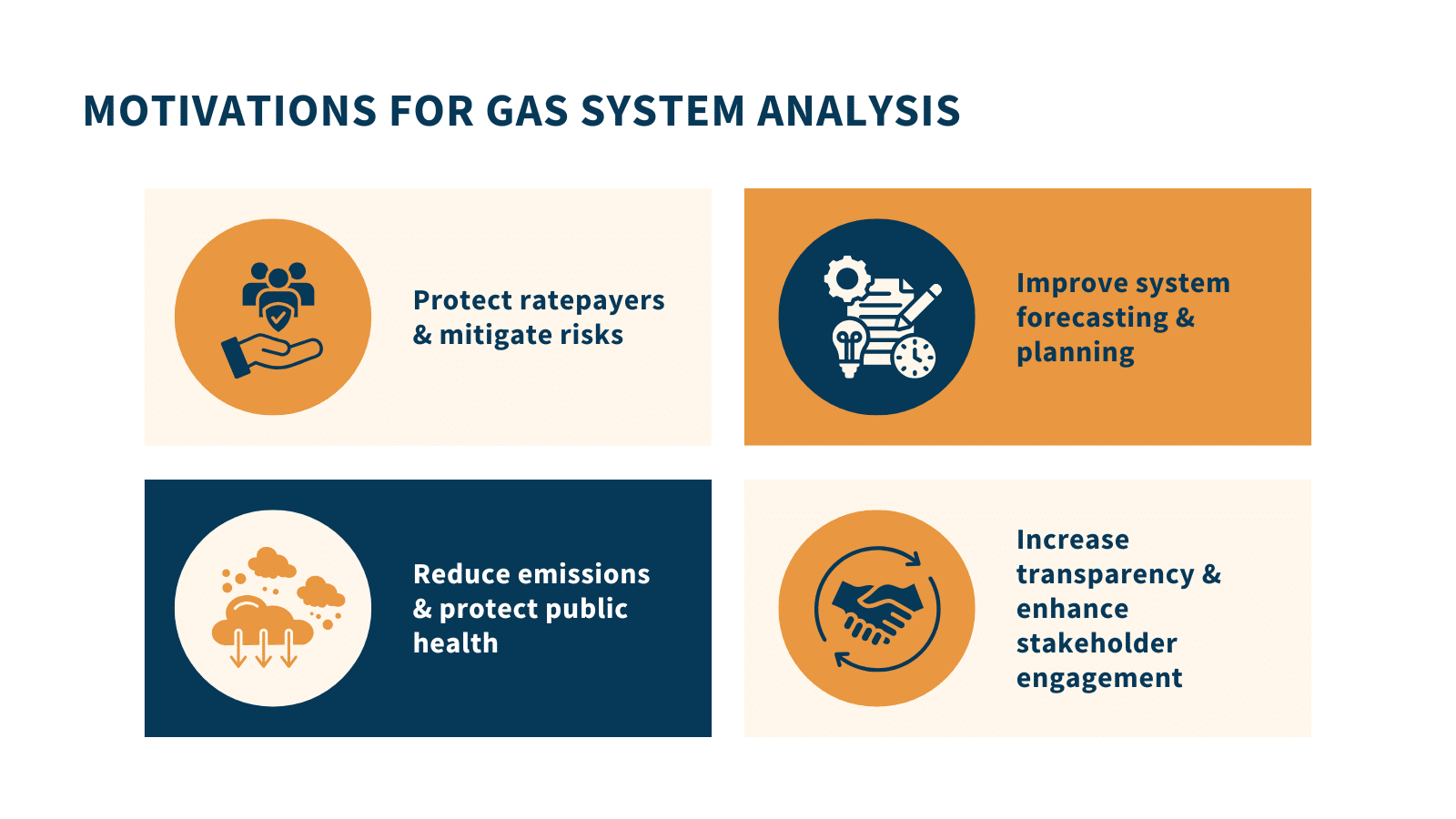
Decision-makers overseeing gas and electric utilities are responsible for determining the fiscal prudence of proposed utility infrastructure investments, while also directing utilities to pursue solutions and innovations that contain costs and minimize risks to consumers.
Many states and utilities have implemented an array of electric utility solutions to support affordability goals and minimize consumer risks—such as integrated resource planning, distribution system planning, demand response and energy efficiency measures, flexible grid solutions, grid enhancing technologies, performance-based ratemaking, and other regulatory reforms.7 In addition, deploying electrification technologies like electric vehicles and heat pumps has untapped potential to support the more efficient utilization of the electric grid and could put downward pressure on electric rates over time. While more can be done to ensure affordable electric rates going forward, we have a full toolbox of proven approaches to use.
Gas utility solutions, however, are more nascent and uncharted. In addition, the longstanding presumption of ever-expanding dual energy systems is only now being called into question. But evaluating a gas utility’s system is not a straightforward exercise. First, not only is most gas infrastructure invisible to the eye—distribution pipelines are buried up to three feet below the surface, often under roads and sidewalks—but not all gas utilities are required to submit detailed information about their systems.8 Second, pipeline safety and compliance staff may not interface with those evaluating system economics and customer impacts. And third, decision-makers may lack the technical background to comprehensively evaluate the merits of gas utility proposals.
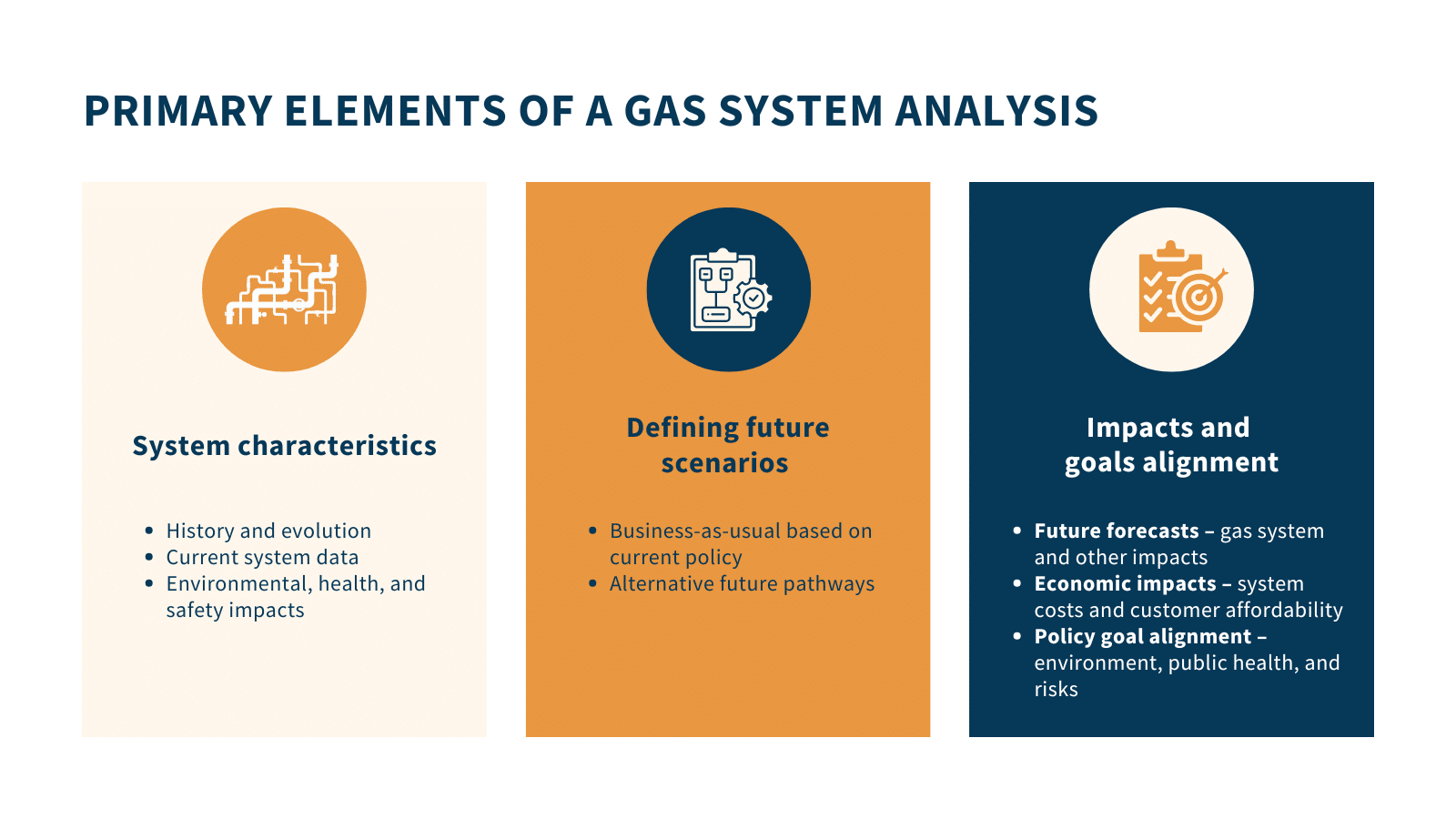
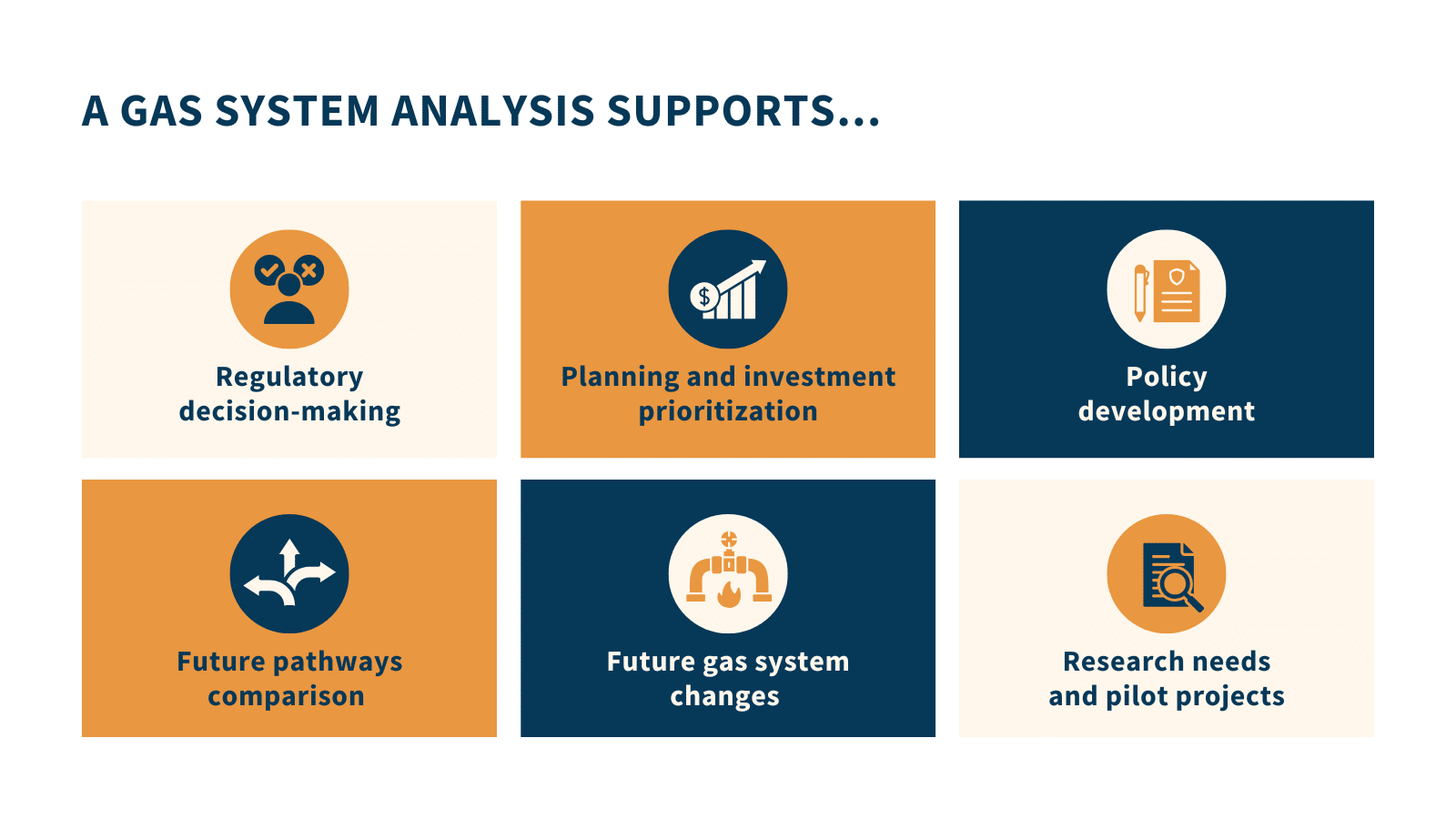
Evaluating gas system investments requires new approaches, relevant technical information, and updated frameworks. A gas system analysis is an integral tool that can provide regulators, municipal gas utility boards, and non-utility stakeholders with foundational information about gas utility distribution, transmission, and storage systems to help make more informed decisions.
[1] “Table 2.1. Number of Ultimate Customers Served by Sector, by Provider (2014-2024),” U.S. Energy Information Administration Electric Power Annual, 2024, https://www.eia.gov/electricity/annual/table.php?t=epa_02_01.html.
[2] “U.S. EIA Natural Gas,” Number of Natural Gas Consumers, 2019-2024, November 28, 2025, https://www.eia.gov/dnav/ng/ng_cons_num_dcu_nus_a.htm.
[3] Sonal Patel, “Investor-Owned Utilities to Spend $1.1T in Grid Boost as Power Demand Spirals,” Power, October 9, 2025, https://www.powermag.com/investor-ownedutilities-to-spend-1-1t-in-grid-boost-as-power-demand-spirals/.
[4] “Gas Utility Construction Capital Expenditure,” American Gas Association, 2025, https://www.aga.org/research-policy/resource-library/gas-utility-construction-capitalexpenditure/.
[5] Dorie Seavey, Leaked & Combusted: Strategies for Reducing the Hidden Costs of Methane Emissions & Transitioning off Gas, HEET, 2024, https://assetsglobal.websitefiles.com/649aeb5aaa8188e00cea66bb/663a27270c0fa4fffcfe447d_Leaked-andCombusted-May-2024.pdf.
[6] Lucero Marquez et al., Residents of 49 States and Washington, D.C., Face Increasing Electric and Natural Gas Bills, Center for American Progress, 2025, https://www.americanprogress.org/article/residents-of-49-states-andwashington-d-c-face-increasing-electric-and-natural-gas-bills/.
[7] Matthew Land et al., US Governors Are Leading Efforts to Tackle the Cost of Electricity, RMI, 2025, https://rmi.org/us-governors-are-leading-efforts-to-tackle-thecost-of-electricity/; Hal Harvey and Sonia Aggarwal, America’s Power Plan Overview: Rethinking Policy to Deliver a Clean Energy Future, Energy Innovation, 2013, https://energyinnovation.org/report/overview-rethinking-policy-to-deliver-a-cleanenergy-future/.
[8] Megan Anderson et al., Under Pressure: Gas Utility Regulation for a Time of Transition, Regulatory Assistance Project, 2021, https://www.raponline.org/wpcontent/uploads/2023/09/rap-anderson-lebel-dupuy-under-pressure-gas-utilityregulation-time-transition-2021-may.pdf.
