Get Access
Your information will not be used for marketing purposes and we never sell your data!
All research licensed under CC BY 4.0
Executive Summary
At least 74 countries have released national strategies or roadmaps on hydrogen.[1] These plans recognize that low-emissions hydrogen—a gaseous molecule produced in a manner that emits relatively little climate pollution and used as a chemical feedstock and energy carrier—is important to solving climate change. It also offers opportunities for governments to improve industrial competitiveness, innovate and invest in their energy sectors, and enhance national security. However, these plans are running up against economic and technological realities, often first in energy regulation.
Energy regulators who oversee electricity and gas networks, wholesale markets, and retail markets take these plans or policy targets and have to dig several layers deeper into implementation. A common realization, and perhaps the central challenge, is that the future of hydrogen is highly uncertain. The International Energy Agency’s (IEA) recent change to its low-emissions hydrogen demand forecast for 2050 exemplifies this uncertainty: It fell by nearly a quarter from its 2021 to its 2024 Net Zero Emissions by 2050 (NZE) Scenarios to 401 million metric tons (MMT), and various organizations’ 2050 hydrogen demand forecasts differ by more than 200 MMT.[2]
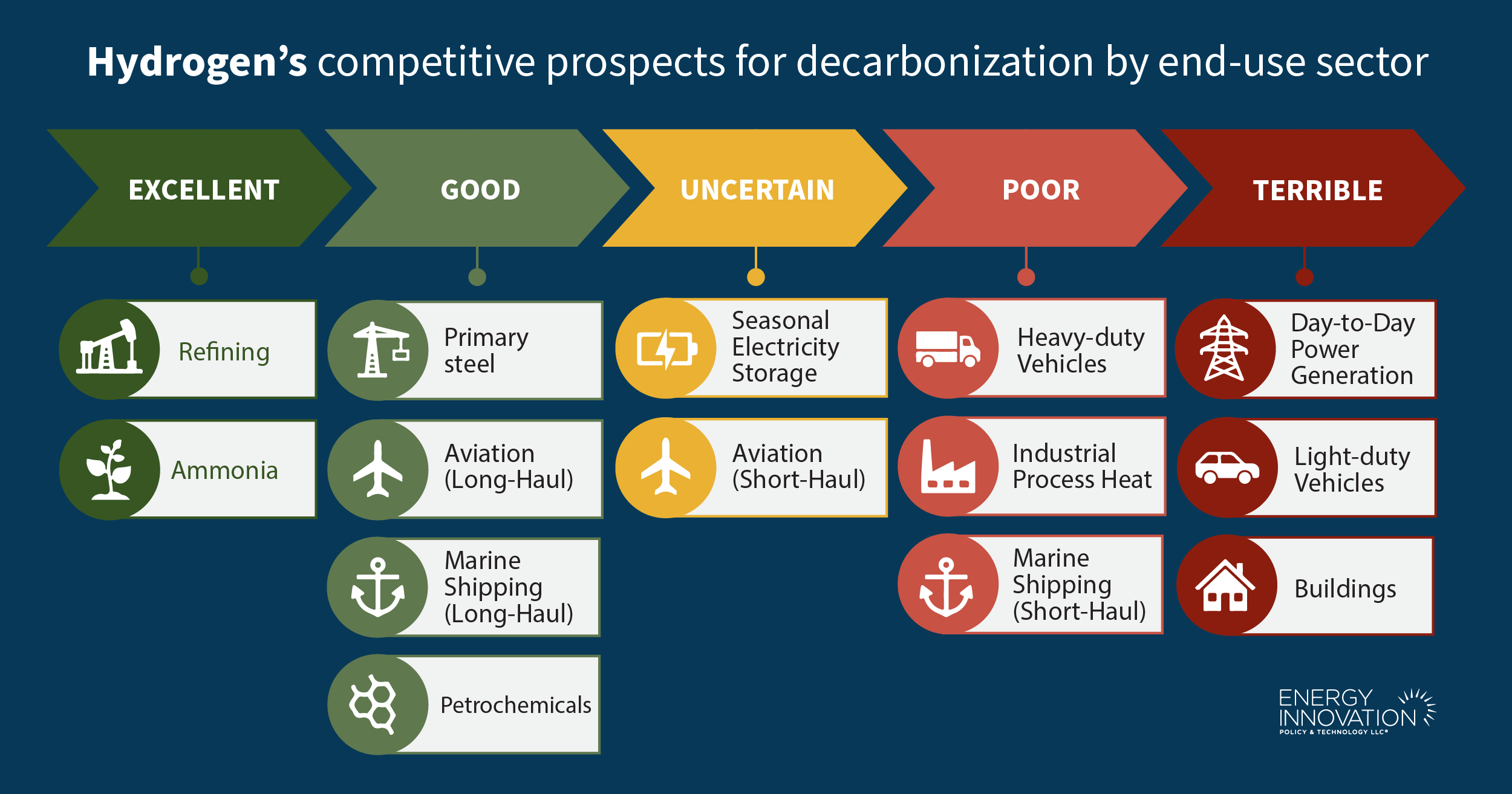
While low-emissions hydrogen can develop a new clean industrial base that serves and decarbonizes myriad end uses, it is difficult to actually reduce emissions from hydrogen production, and it competes in each sector with other clean technologies on their own learning paths. A complex range of possibilities emerges that depends heavily on policy, technology, and economics. On one hand, reaching net-zero emissions requires decarbonizing and likely vastly increasing hydrogen production. On the other, mismanaged hydrogen production can fail to adequately reduce—and even worsen— climate pollution, and hydrogen is not well suited as an energy carrier in many of the areas in which it is being considered. Ultimately, hydrogen policy goals are not good indicators of real-world demand, as buyers seek a cost-effective, low-emissions product.
A quandary lies at the center of regulating energy under ambitious hydrogen policy: Regulators risk approving investments that will be stranded and saddling customers with the bill if they are too bullish, but they can also stifle needed growth in hydrogen development if they are too reactive. Regulators can differentiate hype from reality by starting now to think through and plan for the many ways low-emissions hydrogen’s production and use may affect regulated energy systems. The uncertainty of future demand complicates regulators’ jobs as they oversee existing electricity and gas networks and assess regulated companies’ role in delivering hydrogen to chemical producers, industrial factories, and other end-users seeking to reduce their climate impacts. To enable this future, regulators need to develop and reinforce technical capabilities on hydrogen and learn from one another about emerging best practices.
To assist regulators grappling with hydrogen’s role in future energy systems, Energy Innovation and the Regulatory Energy Transition Accelerator (RETA) co-convened two discussions with regulators from around the globe. The sessions focused on regulators’ experiences and decisions regarding low-emissions hydrogen, as well as regulatory peer-to-peer discussions to identify common issues and research needs. The workshops made clear that there is a need to develop proactive approaches that balance meeting hydrogen policy goals with regulators’ remit to ensure affordable, reliable, and safe energy services for all customers.
This paper provides energy regulators with a primer on hydrogen regulatory considerations as well as a strategic framework to begin developing the right approach for their jurisdictional context. We provide an overview of issues and give examples of regulatory responses within energy regulators’ purview, including recommendations to address specific questions and priorities related to hydrogen. We also shed light on public policy considerations that will impact regulatory decisions but are outside of most energy regulators’ scope.
[1] The International Renewable Energy Agency, “Green Hydrogen Strategy: A Guide to Design,” International Renewable Energy Agency, 2024, https://www.irena.org/-/media/Files/IRENA/Agency/Publication/2024/Jul/IRENA_Green_hydrogen_strategy_design_2024.pdf.
[2] International Energy Agency, “World Energy Outlook 2024,” International Energy Agency, 2024, tbl. A.28, https://iea.blob.core.windows.net/assets/140a0470-5b90-4922-a0e9- 838b3ac6918c/WorldEnergyOutlook2024.pdf.