Get Access
Your information will not be used for marketing purposes and we never sell your data!
All research licensed under CC BY 4.0
Executive Summary
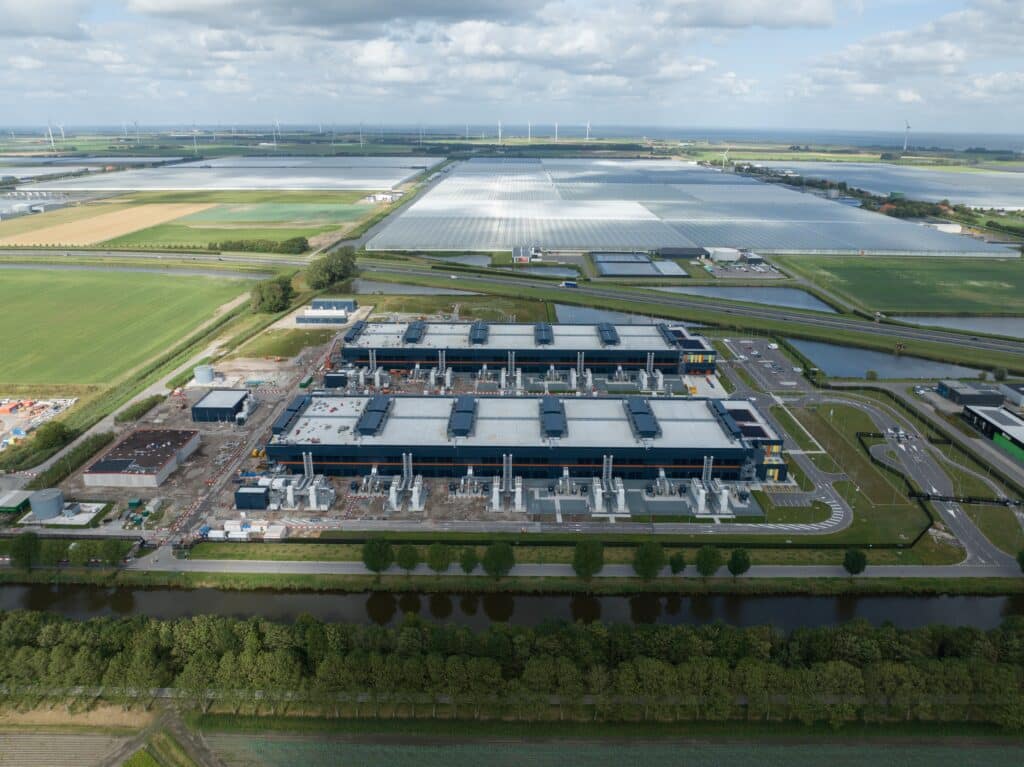
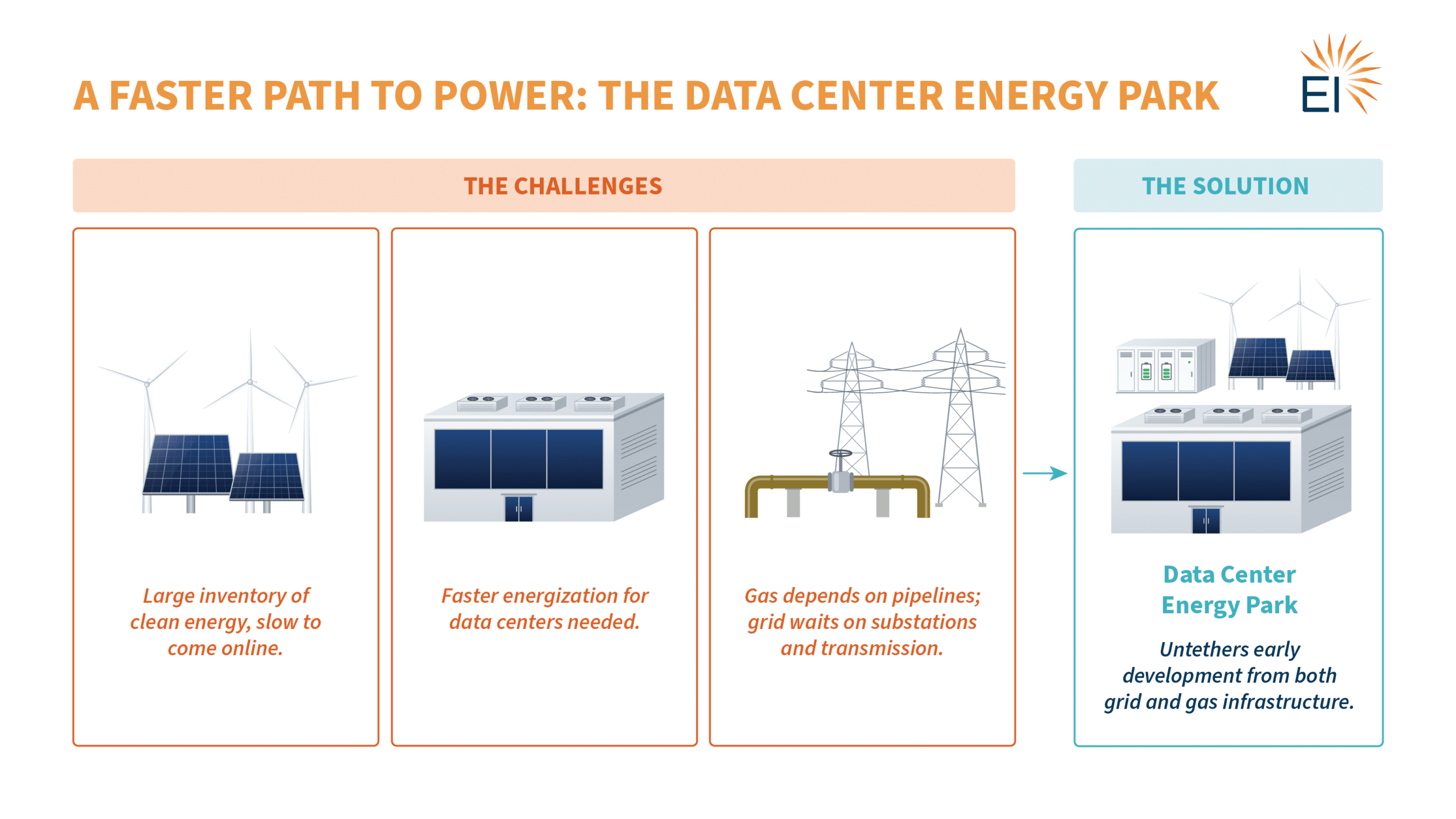
The United States’ insatiable demand for new data centers could reach 118 GW installed capacity by 2030,[1] but powering the data center boom faces bottlenecks including building new electric generation capacity, connecting to the grid, and building new natural gas infrastructure.
“Speed to power” pressure to meet new data center demand has encouraged developers to consider co-located generation, including a proposed pipeline of roughly 90–189 GW of gas generation[2] for so-called “bridge power,” off-grid or near-grid generation that bridges a data center’s needs until a grid connection can be achieved.
Meanwhile the U.S. also has 773 GW of solar, 220 GW of wind, and 749 GW of battery storage in interconnection queues, struggling to reach operation due to long delays that drive historically low completion rates.[3] Historically, only 13 percent of capacity submitted from 2000 through 2020 to interconnection queues ended up connected and commissioned by December 2025. More than 170 GW of clean energy projects have been “safe-harbored” for federal tax credits, meaning developers have already made meaningful progress although they may not yet have viable end-customers (offtakers) and paths to market.
Gas plants still depend on pipelines, while grid-connected projects depend on substations and transmission upgrades—precisely the infrastructure bottlenecks that can delay energization for years.
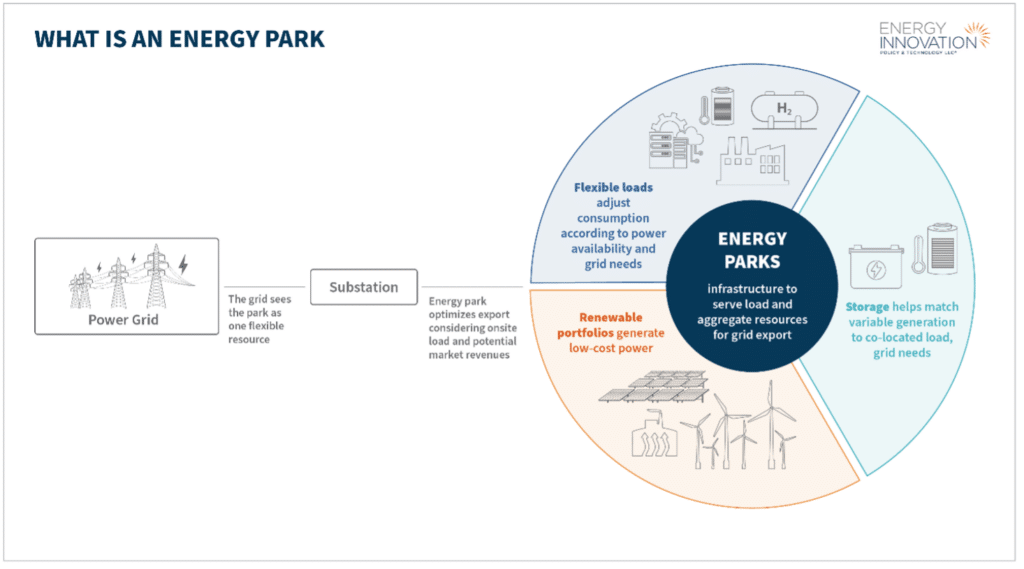
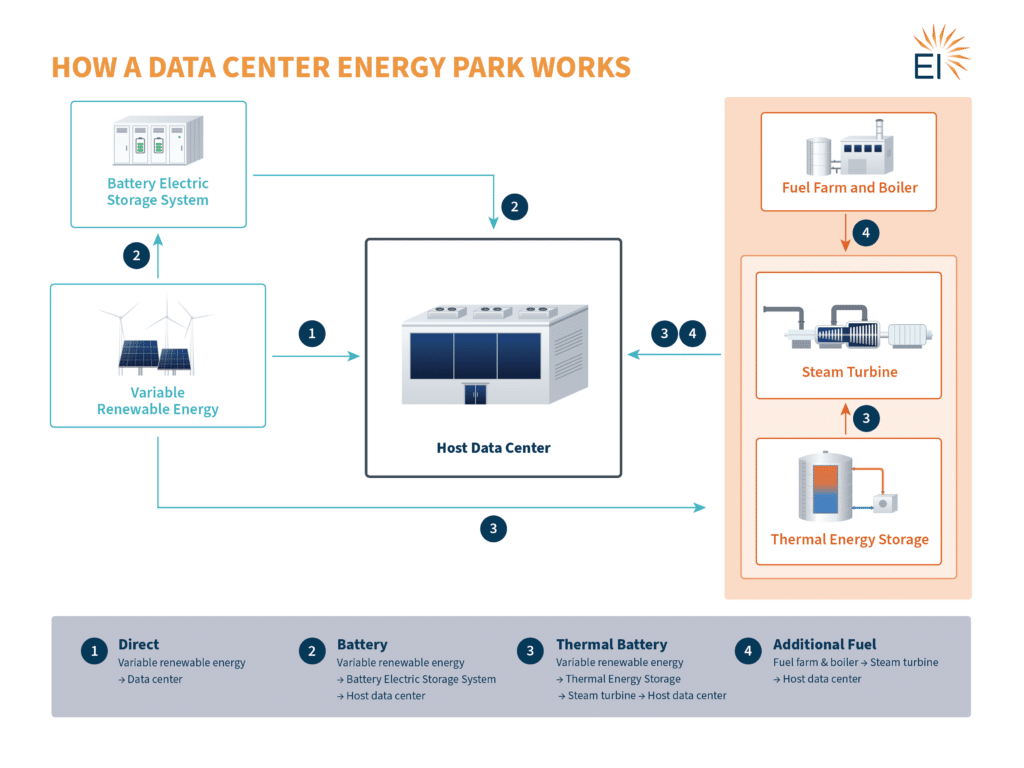
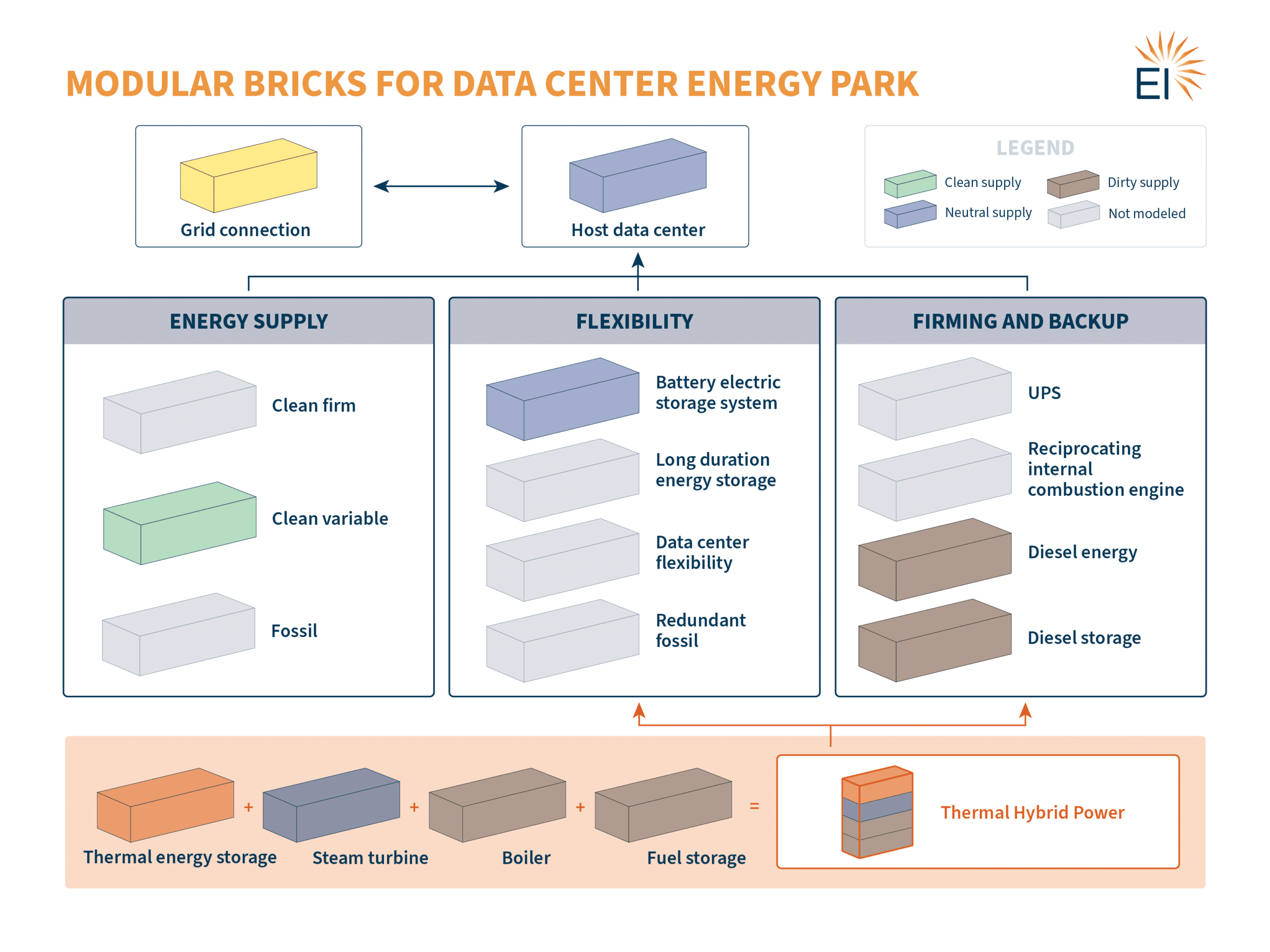
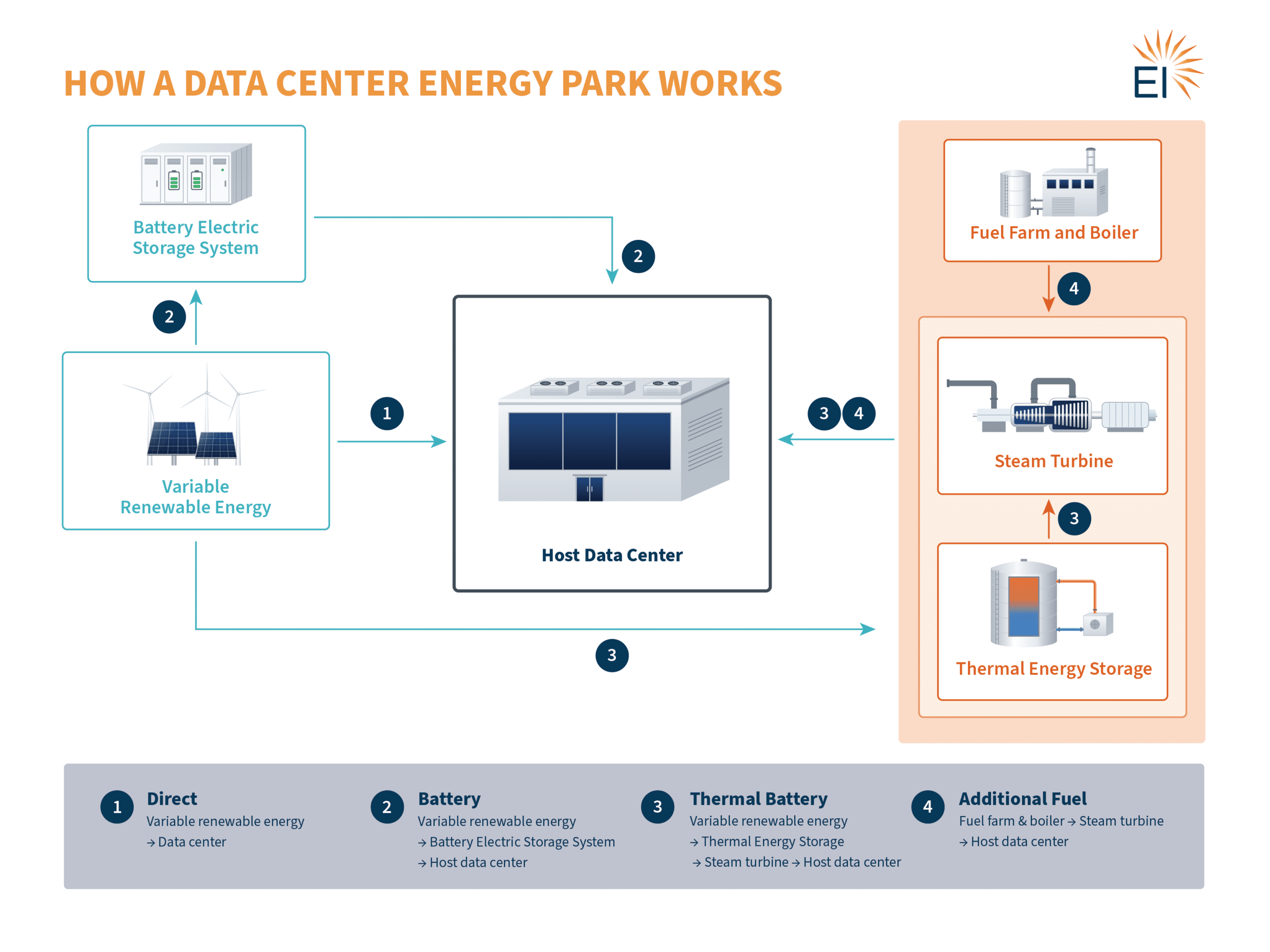
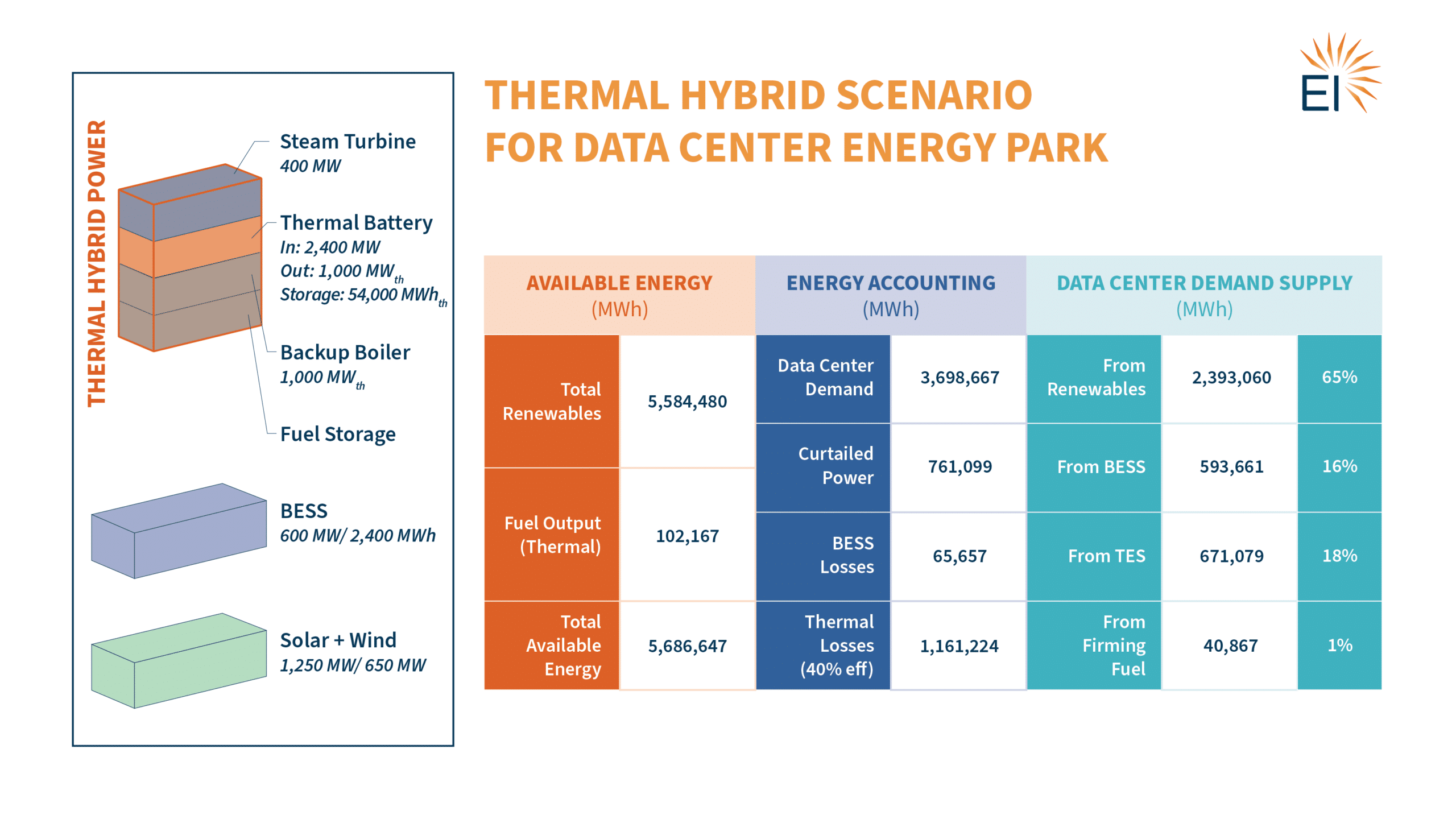
This paper proposes a solution: Matching renewable energy projects and data centers in energy parks[4] alongside BESS and a collection of thermal energy storage, steam turbines and boilers – a concept we call “thermal hybrid power.” This type of energy park can be built without any initial connection to wires and pipelines.
Project developers for data center energy parks have the freedom to choose whichever power delivery option makes the most sense if it complies with local permitting and air pollution rules. Matching with clean energy resources is just one more option. Where many projects lack freedom, however, is in the way they must tether to existing energy infrastructure.
Co-locating generation, storage, and load in a data center energy park offers a potentially valuable outlet and could be a tailwind for renewables[5] but the match between renewables, batteries and data centers is incomplete – historical renewable energy projects typically cannot meet data center power availability metrics without other supply tied to existing wires and pipelines.
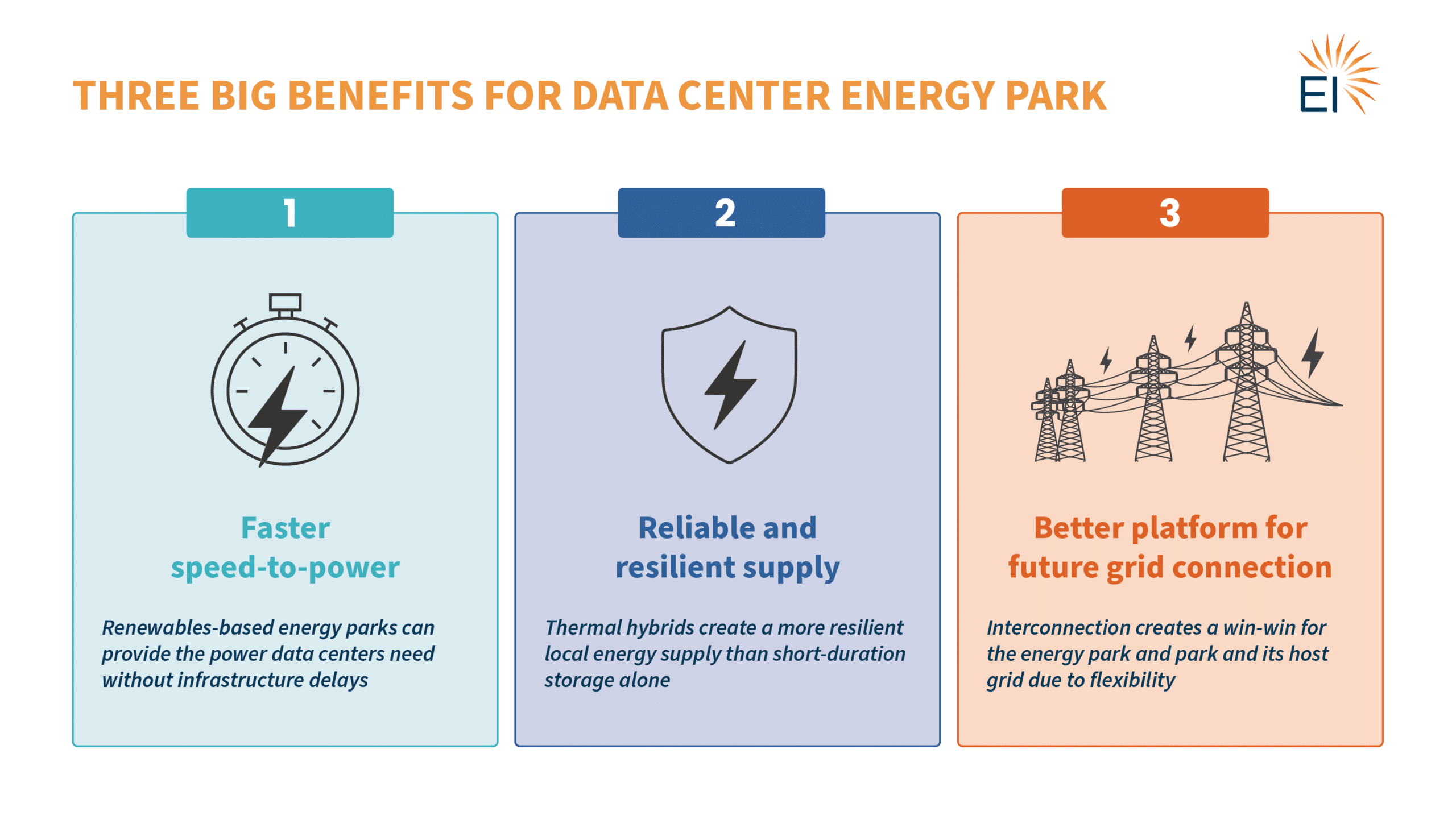
This thermal layer is the missing piece that allows variable renewable generation to approach the availability required by large data centers: Thermal storage carries excess renewable energy across longer periods (9x more electrical storage capacity versus the chemical battery), while inexpensive fuel-fired boilers provide a limited backup energy source using the same steam turbines to supplement supply during the most difficult renewable droughts and contingencies.
The result is an energy park that can initially operate without waiting for either a grid connection or a gas pipeline, accelerating speed-to-power while providing reliable and resilient supply—creating an attractive platform for later grid connection and additional onsite data center capacity.
An hourly resolution screening model shows this “thermal layer” data center concept can remove pipeline bottlenecks by requiring up to around 1 percent fuel-use to meet data center electricity needs––a threshold that removes the need for a pipeline. This path combines wind, solar, and battery storage (four hours of storage at full output) with a thermal hybrid power layer consisting of thermal batteries (54 hours of storage at full output), steam generation, and backup boilers.
Our modeling:
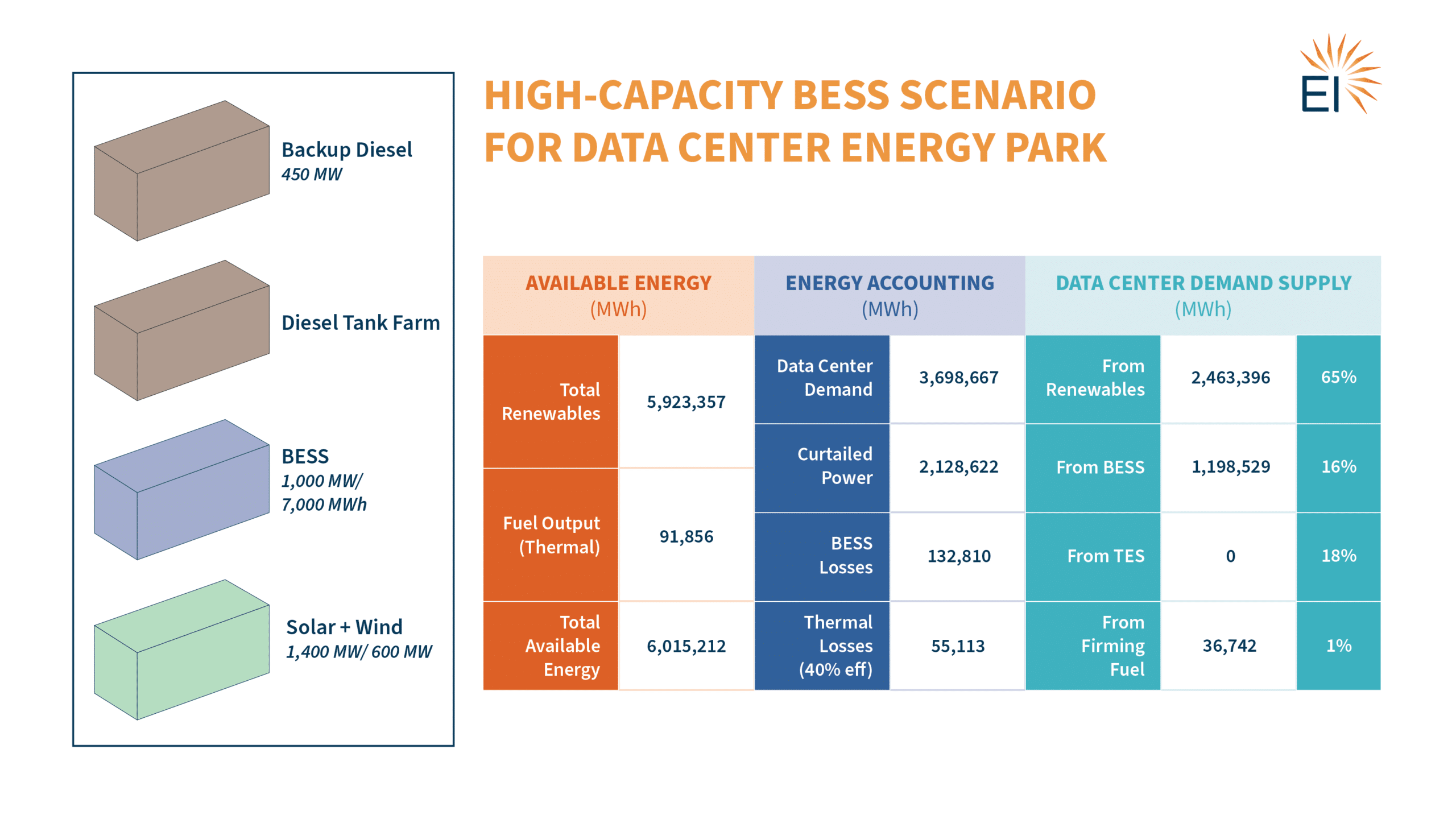
- Identifies two scenarios with candidate clean “speed-to-power” portfolios of resources in energy parks that can cost-effectively supply a data center for a first-pass annual reliability study with one percent on-site fuel use. These don’t need a pipeline or grid connection and thus could provide faster speed-to-power. The first uses only renewables and BESS backed up by diesel engines, while the second features novel hybrid thermal power.
- Subjects candidate portfolios to deeper analysis with multiple scenario sensitivities that show a clear resilience advantage for the hybrid thermal power scenario, while raising doubts about the scenario with just conventional elements. This separation in reliability outcomes for hybrid thermal power is the result of a larger (4x) possible stock of stored clean energy in all modeled hours.
- Compares the performance and grid-trading behavior of energy parks in each scenario once connected to the bulk power system, varying the interconnection size. It finds considerable reliability and financial connection benefits for the data center energy park and the host grid without needing firm grid delivery service commitments. This might accelerate connection timetables and allow increased hosting of data center capacity on site at a small incremental cost.
We encourage data center site developers interested in “speed-to-power” and renewable energy developers interested in increased business opportunities to consider an energy park solution with thermal hybrid power. The underlying thermal battery technology is already commercially deployed for industrial heat and steam, including an operating installation supplying steam for electricity generation.[6] The conventional boilers and steam turbines we include in our models draw on established industrial equipment and supply chains.[7] Thermal hybrid energy parks are a promising option worthy of further detailed engineering study and commercial development.
[1] Leslie Kaufman and Will Wade, “U.S. Clean Energy Set to Reach New Highs as Tax-Credit Cliff Looms,” Bloomberg, October 2026, https://www.bloomberg.com/news/articles/2026-10-16/us-clean-energy-set-to-reach-new-highs-as-tax-credit-cliff-looms/.
[2] Michael Thomas, “Scoop: Amazon Is Behind One of the Largest Planned Gas Power Plants in the US,” Cleanview Newsletter, August 2026, https://globalenergymonitor.org/research/us-gas-power-proposals-tied-data-centers-nearly-double-six-months/.
[3] Joseph Rand, Anna Cheyette, Chris Talley, Steven Zhang, Will Gorman, Ryan H. Wiser, Joachim Seel, Seongeun Jeong, and Fredrich Kahrl, “Queued Up: 2026 Edition: Characteristics of Power Plants Seeking Transmission Interconnection as of the End of 2025,” Lawrence Berkeley National Laboratory, 2026, https://emp.lbl.gov/queues/.
[4] Eric Gimon, Mark Ahlstrom, and Mike O’Boyle, “Energy Parks: A New Strategy to Meet Rising Electricity Demand,” Energy Innovation, December 2024, energyinnovation.org/report/energy-parks-a-new-strategy-to-meet-rising-electricity-demand/.
[5] Leslie Kaufman and Will Wade, “U.S. Clean Energy Set to Reach New Highs as Tax-Credit Cliff Looms,” Bloomberg, October 2026, https://www.bloomberg.com/news/articles/2026-10-16/us-clean-energy-set-to-reach-new-highs-as-tax-credit-cliff-looms/.
[6] Rondo Energy, “Rondo Powers Up World’s Largest Industrial Heat Battery,” Rondo Energy, October 2025, https://www.rondo.com/news-press/rondo-powers-up-worlds-largest-industrial-heat-battery/.
[7] Babcock & Wilcox, “Babcock & Wilcox Selects Siemens Energy to Supply Steam Turbine Generator Sets for Applied Digital Data Center Power Project,” Babcock & Wilcox, January 2026, https://www.babcock.com/home/about/corporate/news/babcock-and-wilcox-selects-siemens-energy-to-supply-steam-turbine-generator-sets-for-applied-digital-data-center-power-project/. ; Babcock & Wilcox, “Babcock & Wilcox Signs Agreement with Siemens Energy to Commence Work on 20 Steam Turbines for Data Center Power Generation,” Babcock & Wilcox, August 2026, https://www.babcock.com/home/about/corporate/news/babcock-and-wilcox-signs-agreement-with-siemens-energy-to-commence-work-on-20-steam-turbines-for-data-center-power-generation/.